
Outlook Introduction
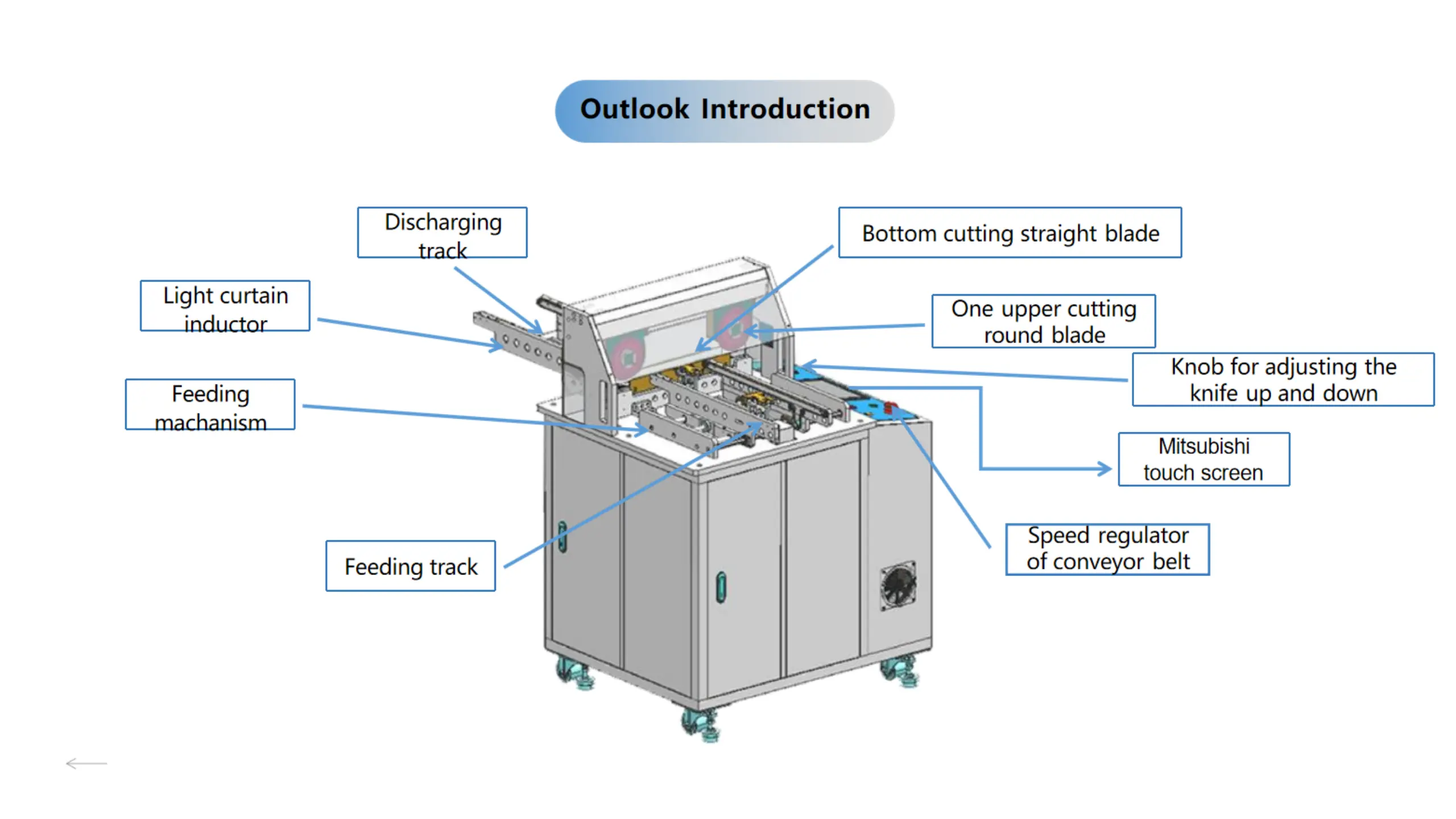
This diagram details the automatic hob type V-CUT separator’s key components and their roles. It has feeding/discharging tracks for smooth PCB flow, a light curtain inductor to stop operations if foreign objects enter, ensuring safety. The cutting system includes blades with an adjusting knob for precise depth control. A Mitsubishi touch screen enables intuitive operation, and a conveyor speed regulator suits different product sizes. All parts work together for high-precision, user-friendly automated PCB depaneling, fitting electronics manufacturing needs.
Machine Structure
It features a transmission shaft of feeding conveyor belt that drives the belt to transport PCBs smoothly. The adjusting block for feeding support frame allows for flexible adjustment to accommodate different product widths, as indicated by the “120MM width” marker. These components work together to ensure stable and adaptable feeding, laying a solid foundation for the subsequent cutting process.

-
Feeding and Clamping Section
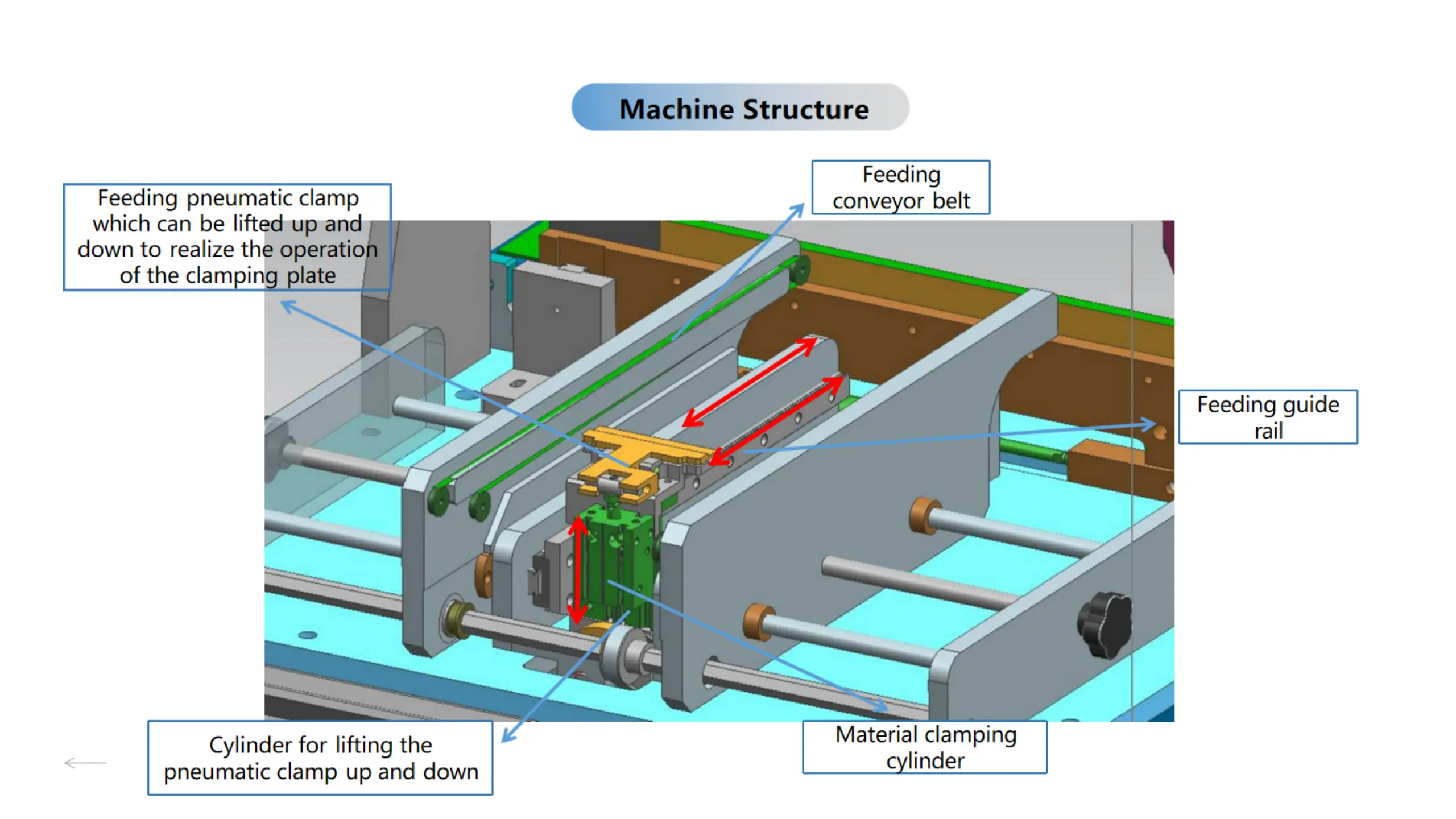
A feeding conveyor belt moves the PCBs along the feeding guide rail for precise positioning. The feeding pneumatic clamp, which can be lifted up and down via a dedicated cylinder for lifting the pneumatic clamp up and down, realizes the operation of the clamping plate. Additionally, a material clamping cylinder ensures the PCB is securely held during cutting, guaranteeing accuracy and stability throughout the process.
Cutting Structure
A light curtain inductor is installed for safety protection. The cutting system consists of an upper cutting round blade that moves repeatedly from left to right, enabling efficient cutting. A lifting cylinder for cutting straight blade and a lifting mechanism for cutting straight blade work in coordination to adjust the position of the straight blade, ensuring precise V-CUT processing. This well-designed structure achieves both high cutting accuracy and operational safety.

Specification
The specification of the automatic hob type V-CUT separator, covering both functional and dimensional details. In terms of operational parameters, it moves from left to right and can handle PCBs with a cutting width and length ranging from 120-500mm, a thickness of 0.8-1.6mm, and a bottom component height of 15mm for the standard machine. Regarding dimensions, the track height is 950+50mm, the machine length is 550mm, and the track length is 600mm (with an extension of 25mm in front and behind the equipment’s outer frame). These specifications demonstrate the machine’s capability to process a variety of PCB sizes while maintaining a compact structural design, making it well-suited for diverse electronics manufacturing environments.

Main Parts List
The main parts list of the automatic hob type V-CUT separator, along with a schematic of the machine. Key components include 1 piece of PLC for control, 2 pieces of stepping motors and 1 piece of speed regulating motor for power transmission, several bearings for smooth operation, and 1 piece of touch screen for user interaction. The cutting system features round blade and straight blade made of SKH61 material with a hardness of 60, backed by a one-year warranty. Additionally, there are 3 pieces of air cylinders for pneumatic operations. Each component is carefully selected and configured, ensuring the machine’s high performance, precision, and reliability in PCB depaneling processes.

Working Environment Requirements
The working environment requirements for the automatic hob type V-CUT separator. It must operate in a clean room to ensure optimal performance and product quality. The environmental temperature, as well as the indoor temperature, should be maintained within the range of 0 – 40 degrees Celsius. Additionally, the air humidity needs to be between 10% and 80%, the environment noise should fall within 40dB to 80dB, and the vibration speed should be controlled between 1mm/s and 5mm/s. Adhering to these requirements is crucial for the machine to function stably, accurately, and efficiently, thereby guaranteeing the reliability of PCB depaneling processes and the longevity of the equipment.

Production Process
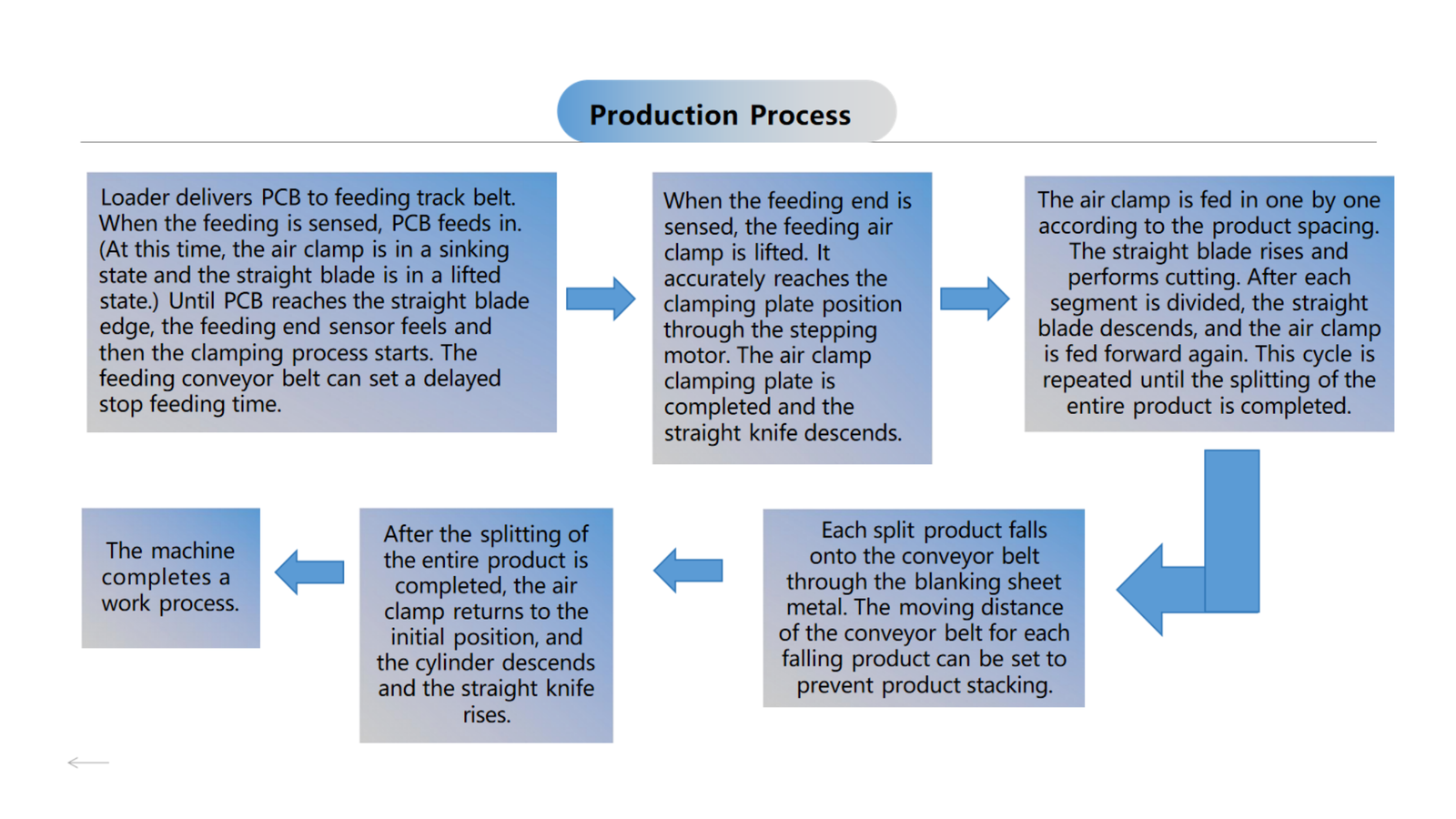
The automatic hob type V-CUT separator’s production process. First, the loader sends PCBs to the feeding track; when sensed, the PCB feeds in (air clamp sinking, straight blade lifting) until it hits the blade edge, triggering clamping with optional delayed belt stop. Next, the air clamp lifts, reaches the plate position via a stepping motor, and the blade descends post-clamping. The air clamp feeds by product spacing, the blade rises to cut, then descends—repeating until splitting. Split products fall to the conveyor (set to avoid stacking). Finally, the air clamp resets, cylinder descends, and blade rises, ensuring efficient automated PCB depaneling.
Description
The description of the automatic hob type V-CUT separator. First, a robotic arm places the board at the splitter’s specified position with ±3mm front-back precision. Then, the splitter’s pneumatic clamping device and product alignment device work together to secure and position the board accurately. Next, the board is fed; when it reaches the set position, the lower straight knife rises and the upper circular knife executes cutting. Finally, split products’ conveying speed is adjusted to equal-distance based on actual product width for smooth output. All steps coordinate to enable efficient, precise automated PCB depaneling.

Features
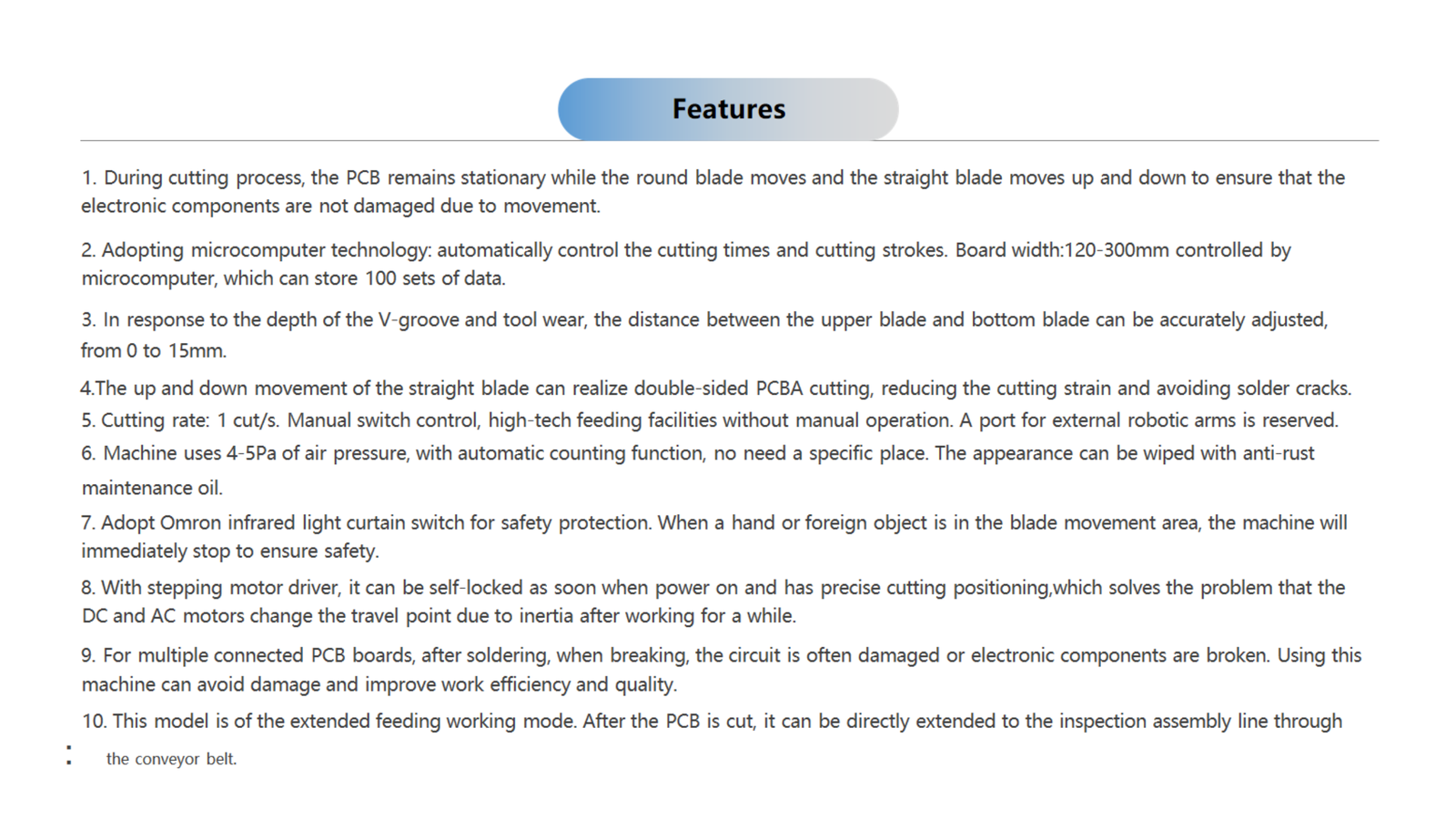
The automatic hob type V-CUT separator has excellent features. It keeps PCBs stationary while the round blade moves and straight blade lifts/lowers to avoid component damage. It uses microcomputer tech to control cuts, store 100 data sets, and handle 120-300mm boards. Blade distance (0-15mm) adjusts for V-groove depth/wear, enabling double-sided PCBA cutting. It cuts at 1 cut/s, has a robotic arm port, 4-5Pa air pressure operation, auto counting, and Omron infrared safety. A stepping motor ensures precision, preventing circuit damage; extended feeding sends PCBs to inspection lines.
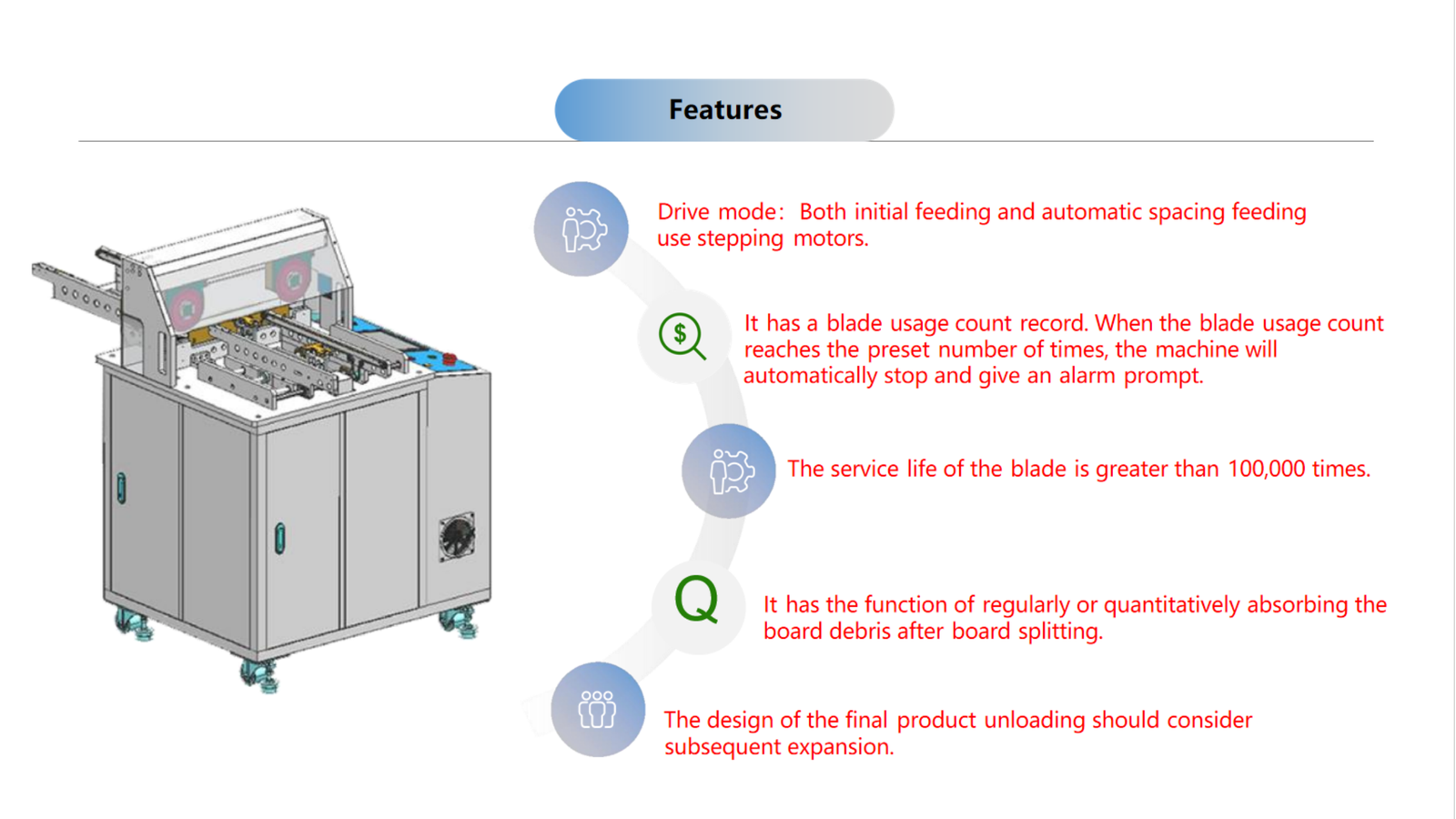
 This diagram highlights extra features of the automatic hob type V-CUT separator. Both initial and automatic spacing feeding use stepping motors for precise, stable material movement. It has a blade usage count—stopping and alarming when hitting a preset number—and blades last over 100,000 cuts for long-term reliability. It also absorbs board debris regularly/quantitatively post-splitting to keep the workspace clean. Final product unloading is designed for future expansion, enabling flexible integration into different production layouts. All these features boost the machine’s efficiency, durability, and adaptability in PCB depaneling.
Conclusion
The automatic hob type V-CUT separator integrates multiple advanced features. It uses stepping motors for both initial and spaced feeding. It records blade usage, alarms when a preset count is reached, and the blade lasts over 100,000 cuts. It absorbs board debris post-splitting and has expandable product unloading, ensuring efficiency, durability, and adaptability in PCB processing.
https://www.youtube.com/@allaismt
For more information, please send an email to
We will respond to your inquiry promptly and provide you with detailed information about our products and services.