Introduction
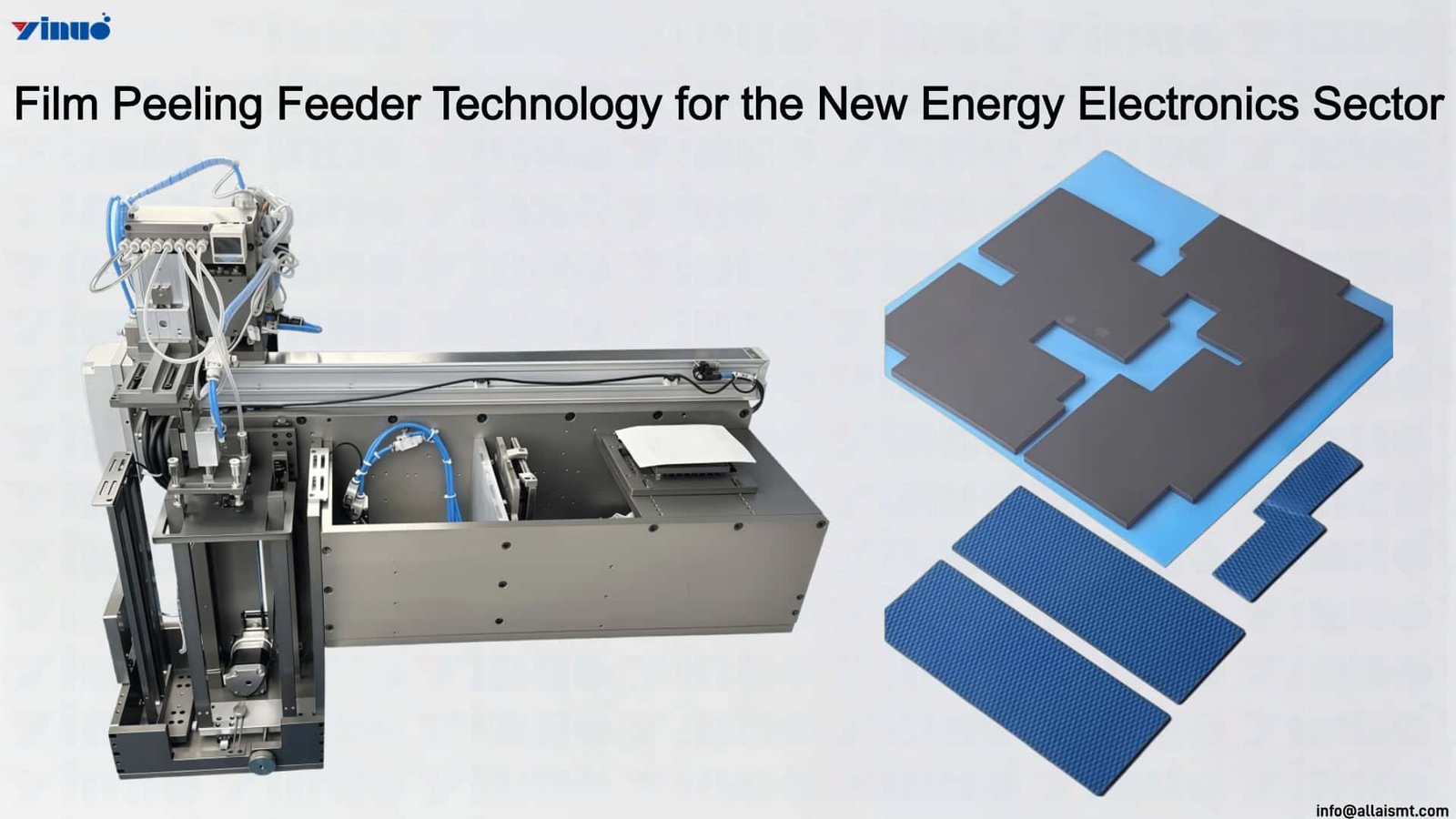
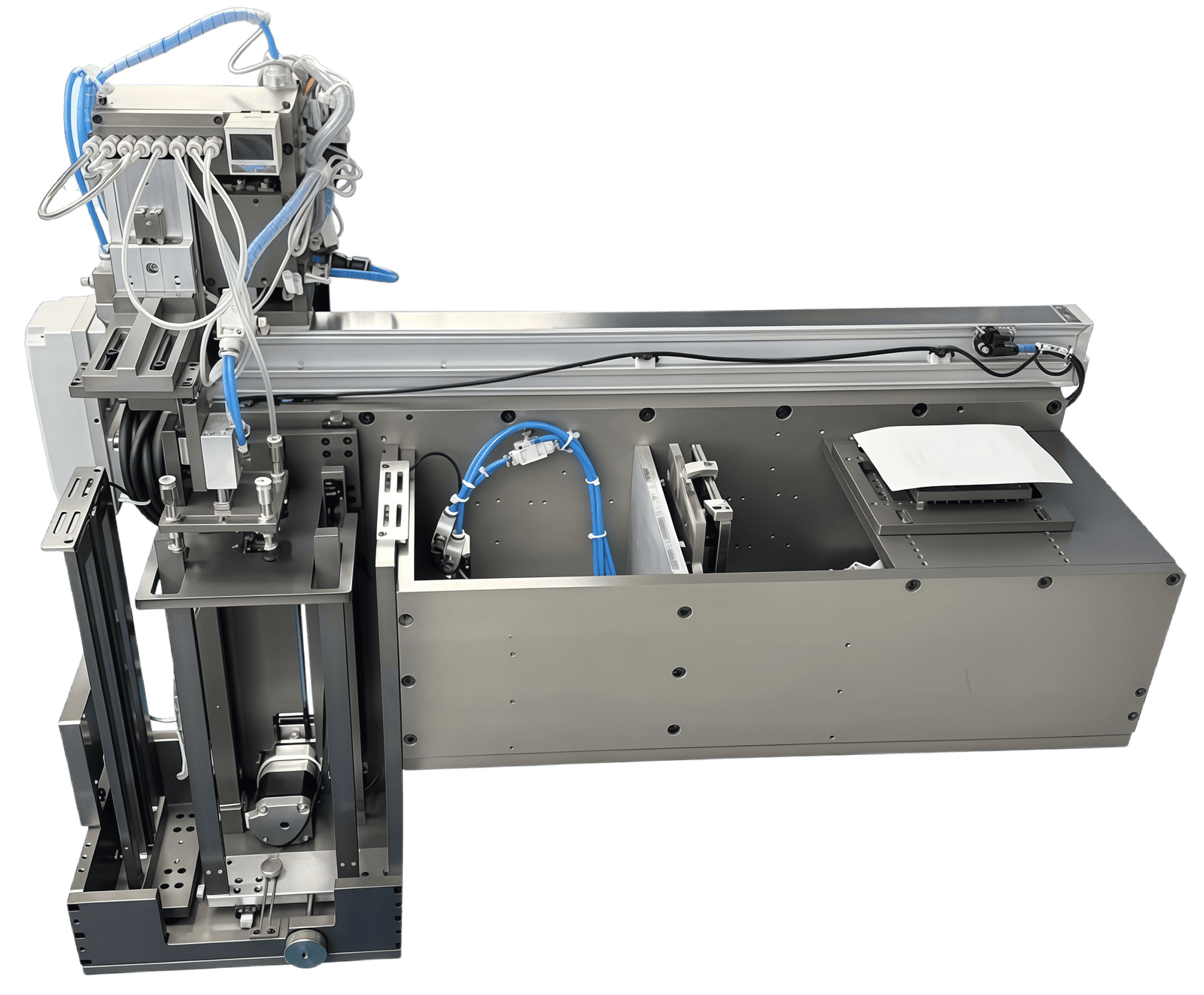
The Sheet Film Peeling Feeder processes single-row and multi-row die-cut sheet materials — protective films, double-sided adhesives, conductive strips, copper foils, foam pads, and thermal layers — that cannot be supplied in roll format. Flat-sheet input reduces conversion costs and expands auxiliary placement options. A suction pad retrieves each sheet from the cassette and transfers it to the peeling station; the peel mechanism clamps the backing at its reserved margin, and as the carriage moves toward discharge, substrate separation occurs synchronously — the backing peels away while the functional layer advances intact. At discharge, the carriage releases the peeled piece onto a vacuum-anchored carrier stage ready for nozzle pickup.
The synchronized peel-and-transfer motion is the defining engineering element. Because peeling happens during transit rather than at a fixed station, the functional material experiences continuous, controlled separation without pause-induced wrinkles or edge lifts. The ≥10mm minimum backing-margin requirement ensures the peeling clamp grips only non-productive film, leaving the active area untouched. Peel stroke length, transfer velocity, and inter-cycle dwell are recipe-programmable, allowing operators to recalibrate between materials of different tack levels, film rigidities, or backing thicknesses through the recipe interface alone — no hardware swaps required.
Material rigidity is a prerequisite: the functional layer must possess sufficient stiffness to hold its geometry during synchronous peel-and-transfer, preventing flex or curl that would compromise placement accuracy. The mechanism contains few kinematic elements, keeping wear rates low and service intervals long. Platform-standard mounting, recipe-driven adaptability, and vacuum-stage positioning combine to make the Sheet Film Peeling Feeder a self-contained, uptime-reliable platform for die-cut sheet materials that exceed roll-format supply limits.
Sheet Film Peeling Feeder
Implementing the Sheet Film Peeling Feeder in Alternative Energy Electronics Assembly
Die-cut sheet auxiliaries — protective films, double-sided adhesive patches, conductive copper foils, EMI shielding strips, foam cushioning pads, and thermal interface layers — arrive in single-row or multi-row flat-sheet formats that resist roll conversion. The Sheet Film Peeling Feeder accepts these materials in their native sheet form, executing a two-stage peel workflow: first the backing film is stripped away, then the functional material is peeled from its remaining carrier for nozzle pickup. This dual-phase approach ensures that each workpiece reaches the extraction point fully separated — backing removed, adhesive exposed, geometry preserved — without manual substrate handling or separate pre-processing stations.
The operational sequence integrates both peel phases into one continuous motion path. A suction cup lifts the sheet from the storage cassette, the transfer carriage moves it to the first peeling station, and the peel clamp engages the reserved backing margin (≥10mm minimum). As the carriage advances toward the discharge position, backing-film separation proceeds synchronously with forward transit — the backing curls away while the sheet continues intact. At discharge, the backing-stripped sheet is placed onto a vacuum-held carrier stage. The second peel phase then separates the functional layer from its carrier base, positioning it at the nozzle extraction point. Material stiffness is essential: the functional layer must resist curl through both stripping stages to maintain flatness at pickup.
The market positioning for manufacturers is straightforward. Flat-sheet input circumvents reel conversion cost and widens the material portfolio. Dual-phase peeling compresses backing removal and material separation into a single automated cycle, eliminating separate pre-peel equipment and manual intervention. One feeder unit consolidates multiple auxiliary-material feeding tasks — reducing capital expenditure, floor-space demand, and spare-part inventory. Mechanically simple, platform-compatible, and recipe-adaptable, the Sheet Film Peeling Feeder delivers the throughput precision and cost efficiency that high-mix production lines require.
Parameters
| Item | Parameter | Item | Parameter |
| Feeding Method | Peel onto anti-adhesion platform, then pick | Operation Panel | 3.5″ TFT touchscreen, 480×320 pixels, capacitive |
| Component Type | Strip components (blank area required at both ends) |
Feeding Speed | Stepless speed control, max 100mm/s |
| Voltage | DC 24.0V | Power Consumption | <20W |
| Current | 5.0A MAX | Operating Temperature | -20~65°C |
| Feeding Accuracy | ±0.5 | Operating Humidity | 20~90%RH, non-condensing |
| Feed Position Adjustment | X: mechanical limit adjustment; Y: software adjustment; Z: mechanical adjustment |
Storage Temperature | -40~85°C |
| Air Supply Spec | 0.40~0.60 MPa | Storage Humidity | 10~95% |
| Communication Interface | GPIO NPN/PNP type | Service Life | ≥20K hrs. (25°C) |
| Hardware Communication | GPIO, RS232, TCP/IP | Dimensions | Per product specification |
| Drive Method | Electric + Pneumatic | Weight | Per product specification |
https://www.youtube.com/@allaismt
For more information about the Sheet Film Peeling Feeder, please send an email to
We will respond to your inquiry promptly and provide you with detailed information about our products and services.