Introduction
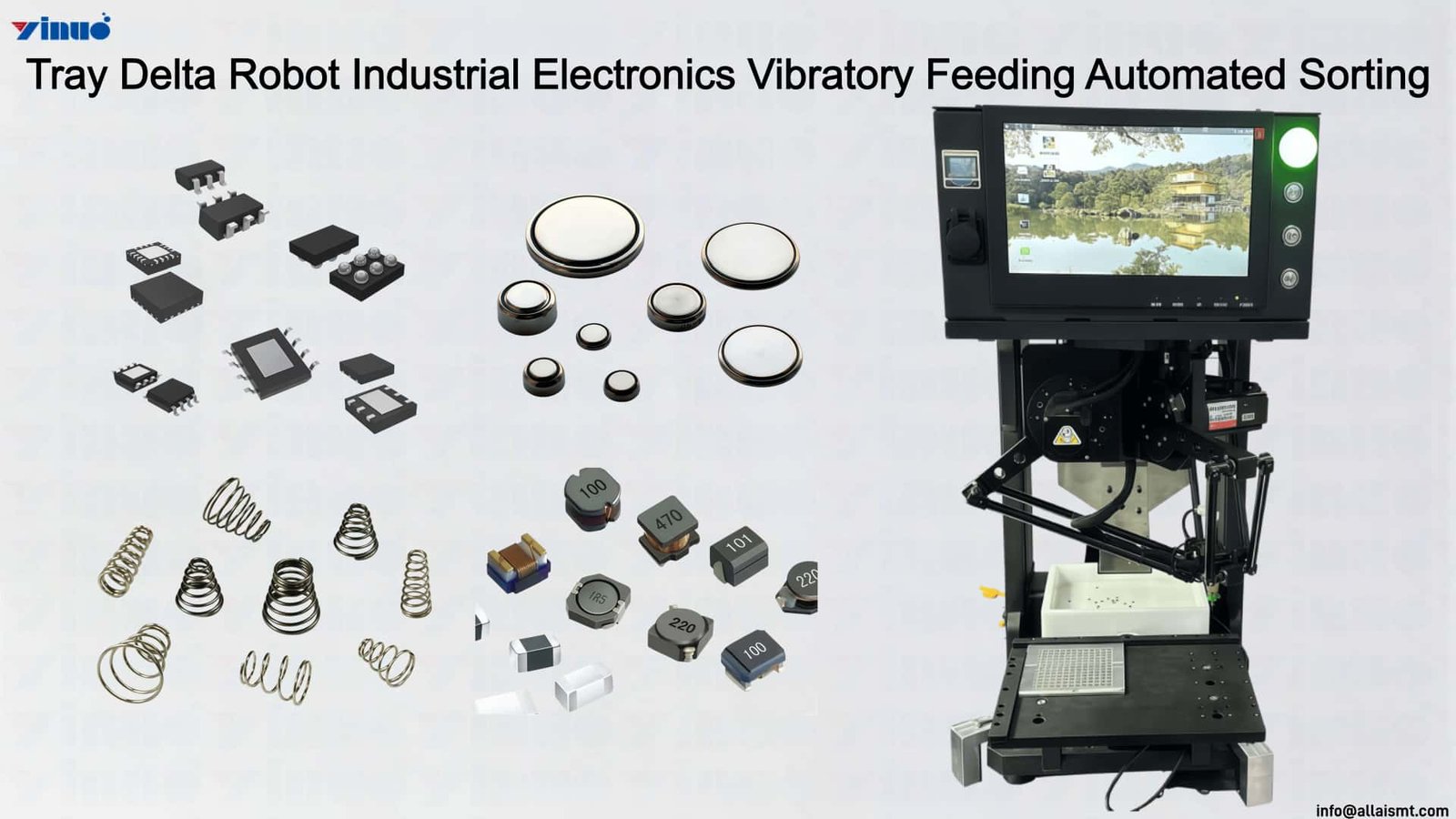
Bulk components enter the Tray Delta Robot system as unorganized populations deposited onto a flexible vibratory feeder, where programmable oscillation parameters—amplitude, frequency, and directional modulation—apply friction-based micro-forces to scatter and progressively orient individual parts. The vibration platform continuously repositions items that fail to meet pickup criteria, cycling through excitation patterns until each part achieves a stable attitude with a recognizable feature facing upward. This persistent agitation ensures that no static congestion zones impede the downstream visual assessment, and that parts previously rejected for unfavorable orientation receive repeated opportunities to reach a compliant posture.
A vision system periodically scans the Tray Delta Robot feeder surface, identifying which parts have attained position and orientation conditions suitable for robotic pickup. The imaging processor extracts centroid coordinates and rotation angles for each qualifying item, while deliberately skipping parts still in transitional or ambiguous states—those overlapped, edge-on, or otherwise inaccessible. Validated targets accumulate into a prioritized dispatch queue, with each entry carrying a designated tray cavity assignment mapped to the part’s dimensional class. The queue refreshes with every new scan cycle, appending newly compliant parts and removing those already retrieved by the manipulator.
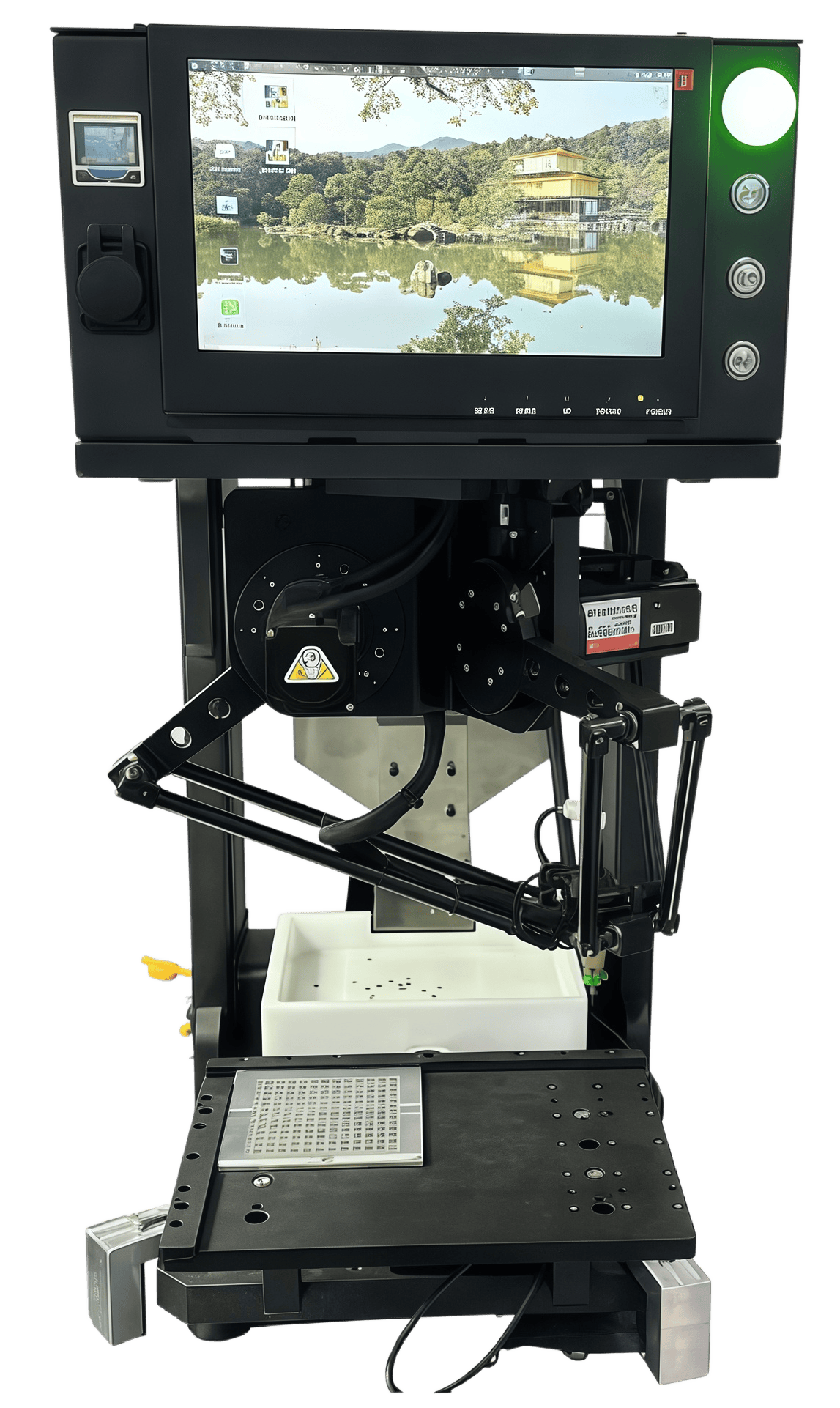
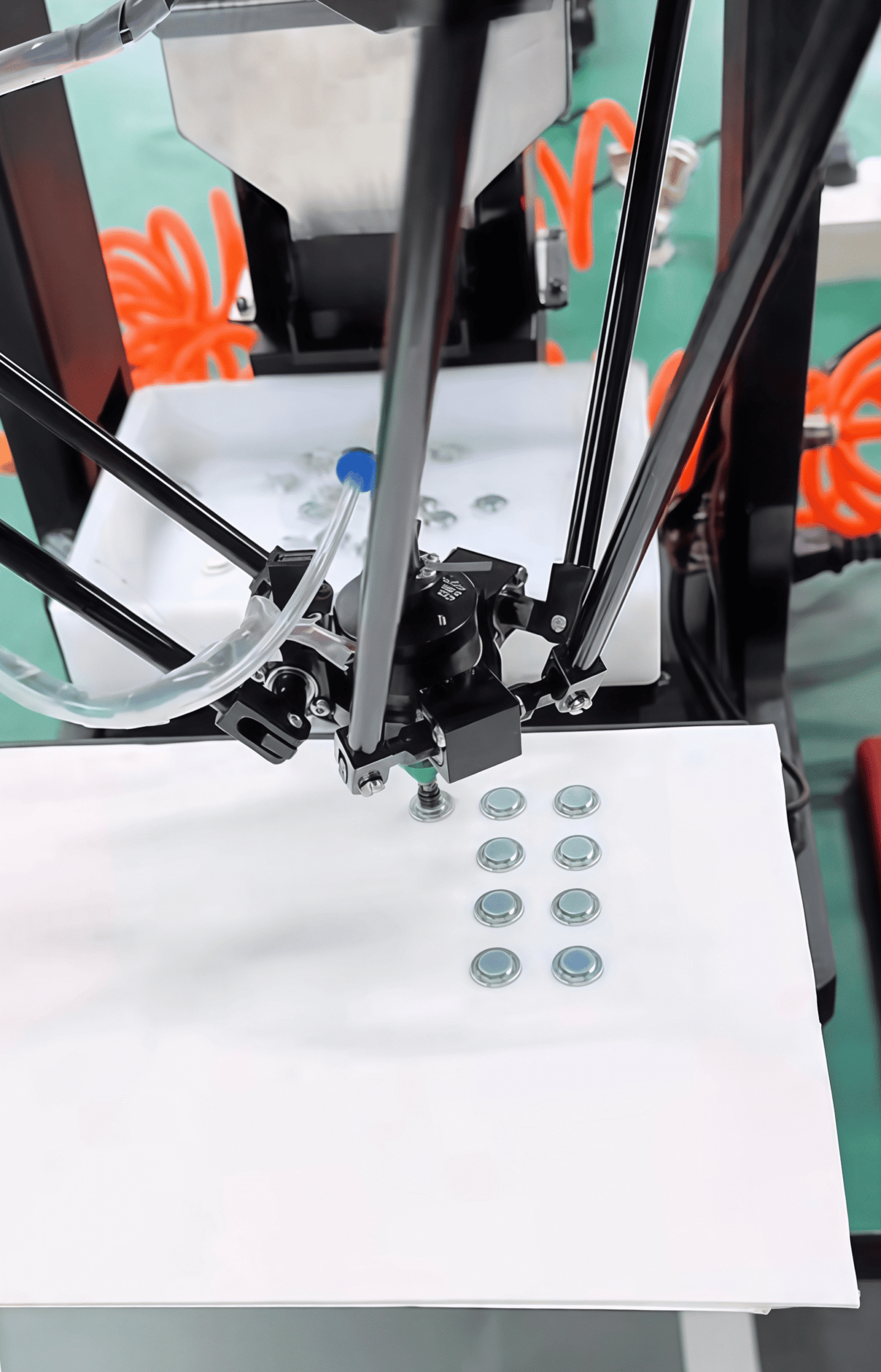
The Tray Delta Robot executes the dispatch sequence by descending at each queued position on the feeder surface, securing the oriented part with an end-of-arm tool, and traversing to the assigned tray pocket for structured placement. The three base-mounted actuators resolve inverse-kinematic trajectories in real time, while the parallelogram linkage constrains the gripper to pure translational motion that preserves orthogonal insertion alignment throughout the transfer arc. Suitable for electronic component tray loading, precision consumable matrix arrangement, and small-part assembly preparation, the Tray Delta Robot closed-loop pipeline of continuous vibration, selective visual recognition, and kinematic deposition transforms heterogeneous bulk input into geometrically ordered tray output without manual intervention.
Tray Delta Robot
Tray Delta Robot Vibratory Feeder Synergy Selective Vision Sorting Kinematic Precision
Collaboration between the flexible vibratory feeder and the Tray Delta Robot’s parallel manipulator defines the system’s distinguishing performance profile: the feeder resolves input disorder while the robot executes ordered output, and neither stage operates in isolation. The vibratory platform applies modulated oscillation—circular agitation, linear sweep, pulsed burst—to raw component populations, generating directional force fields that separate congested clusters and rotate individual items toward upward-facing, pickup-accessible orientations. Because excitation parameters shift dynamically rather than requiring hardware replacement, the feeder accommodates geometry transitions on demand, from thin die-level substrates to bulky molded modules, maintaining a continuous supply of orientation-compliant items that the downstream vision and kinematic stages consume without waiting for batch-specific feeder reconfiguration.
The vision system performs selective screening across the feeder surface, registering position-orientation data only for items that satisfy pickup criteria and forwarding these validated entries to the manipulator’s dispatch queue. Parts failing the threshold remain under vibratory agitation for repositioning and later scan-cycle evaluation, preventing the robot from wasting approach trajectories on inaccessible targets. This feedback loop between feeder and scanner creates a self-correcting population refinement: the feeder progressively increases the compliant-item ratio, while the scanner continuously refreshes the queue with newly eligible parts, producing a steady throughput stream that adapts to real-time part-geometry conditions without operator intervention.
The delta manipulator’s kinematic precision amplifies the feeder’s orientation output by translating each queued pickup coordinate into an inverse-kinematic trajectory resolved at three stationary actuation points. The parallelogram linkage constrains the end-effector to pure translational motion, maintaining orthogonal gripper alignment from feeder descent through tray cavity insertion. Low moving inertia enables aggressive acceleration between densely packed cavity positions, and the overhead-mounted base preserves conveyor access for dense multi-unit deployment. Excels in environments where format diversity and throughput stability compete for the same capital investment, the integrated system delivers higher per-cell format coverage and lower changeover cost than discrete single-format automation alternatives, providing measurable return through reduced line idle time and expanded order-accommodation capacity across fluctuating production schedules.
Tray Delta Robot
Specifications
| Item | Parameters | Remarks | |
| Model | FWD-400F / FWD-400R | FWD-600F / FWD-600R | |
| Overall Dimensions | L530×W345×H701mm | L750×W500×H850mm | |
| Travel Distance | 400mm | 600mm | |
| Payload | 0.5kg | 1kg | |
| Vibratory Tray | L172×W131 | L280×W200 | Custom special trays available |
| Hopper | 1L | Large-capacity custom hoppers available | |
| Number of Nozzles | 1 PCS | ||
| Top Camera | 1200W | ||
| Bottom Camera | 500W | ||
| Precision | Single camera: ±0.15mm / Dual camera: ±0.05mm | ||
| Speed | 3,100~4,500 Pcs/hr | 2,600~3,600 Pcs/hr | |
| Feed Range | 250×200mm | 350×250mm | |
| Voltage | 220V | ||
| Air Pressure | 0.5~0.8MPa | ||
| Weight | 80KG | ||
| Power | 1KW | ||
https://www.youtube.com/@allaismt
For more information about the Tray Delta Robot, please send an email to
We will respond to your inquiry promptly and provide you with detailed information about our products and services.