

Giới thiệu
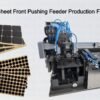
Materials that arrive as single-row or multi-row die-cut sheets — large-format, high-tack, or irregularly shaped — often fall outside the operating range of conventional feeders. Converting these materials into rolled formats adds cost and time, and for certain adhesive-backed or oversized sheets, the conversion itself may be impractical. The sheet retracting feeder accepts die-cut sheets in their supplied form, cutting out the conversion step and reducing material preparation expense.
The core feeding action relies on blade retraction rather than forward peeling. The placement nozzle grips the sheet from above while the blade retracts beneath, pulling the carrier tape away from the material. This approach handles large sheets without flex-induced misalignment and manages high-tack adhesives without residue transfer to the blade. The retraction distance is set to exceed the sheet width, ensuring the entire material surface — including irregular or non-symmetric profiles — detaches cleanly in a single motion.
The feeder delivers high throughput through an automated magazine-to-placement sequence: nozzle pickup, blade retraction, material lift, blade return, and carrier indexing. Multi-row magazine configurations support feeding different sheet geometries from one station, enhancing line flexibility without additional hardware. Material compatibility spans paper labels, protective films, foam, double-sided tape, conductive adhesive, copper foil, steel sheets, and stiffener plates. By accepting die-cut sheets directly and processing them in a continuous retraction cycle, the feeder offers a practical alternative for production environments where material diversity, large sheet dimensions, and adhesive complexity define the feeding challenge.

Bộ cấp liệu thu hồi tấm
Using Sheet Retracting Feeders in New Energy Electronics Board Assembly
New energy electronics production — battery management controllers, inverter power stages, and onboard charger modules — routinely uses sheet-form materials such as thermal pads, insulation films, copper foil, and conductive adhesive sheets. These materials often arrive as die-cut sheets in single-row or multi-row formats, with large dimensions and high-tack adhesive backing. Converting them into rolled stock adds processing cost, extends lead time, and introduces handling stress that can compromise adhesive performance. For oversized sheets or those with aggressive bonding properties, roll conversion is frequently not viable at all.
The sheet retracting feeder accepts die-cut sheets directly, removing the conversion step and its associated expense. The nozzle descends and secures the sheet via vacuum, then the peeling blade retracts in the opposite direction, pulling the carrier away while the material stays stationary. The retraction stroke exceeds the sheet width, ensuring complete detachment even for large-format sheets and high-bond adhesives. This inverse separation avoids tearing, curling, and residue transfer common with forward-peel mechanisms. Irregularly shaped sheets with cutouts or asymmetric edges also separate cleanly, since the blade retracts along a linear path independent of the material profile.
Multi-row magazine configurations allow different sheet types to feed from one station, reducing equipment footprint and simplifying line layout. Programmable stroke, speed, and pitch settings enable quick adjustment between batches without mechanical changes. Interchangeable blade widths support material size changes at the feeder level rather than requiring dedicated feeder units for each format. Stacked magazine loading supports extended unattended operation, keeping throughput steady across shift changes. These capabilities suit the high-mix production typical of new energy manufacturing, where battery packs, inverters, and charging modules shift material requirements from batch to batch.


Tham số
| Mục | Parameter | Mục | Parameter |
| Phương pháp cho ăn | Bóc ra đặt lên bệ chống dính, sau đó nhặt lên | Bảng điều khiển hoạt động | Màn hình cảm ứng TFT 3,5 inch, độ phân giải 480×320 pixel, cảm ứng điện dung |
| Component Type | Các thành phần dải (phải chừa khoảng trống ở cả hai đầu) |
Tốc độ cấp liệu | Điều khiển tốc độ liên tục, tối đa 100 mm/s |
| Voltage | 24,0 V DC | Power Consumption | <20W |
| Hiện tại | TỐI ĐA 5,0A | Operating Temperature | -20~65°C |
| Độ chính xác khi cấp liệu | ±0,5 | Độ ẩm hoạt động | 20~90%RH, không ngưng tụ |
| Điều chỉnh vị trí bộ cấp liệu | X: điều chỉnh giới hạn cơ học; Y: điều chỉnh phần mềm; Z: điều chỉnh cơ khí |
Nhiệt độ bảo quản | -40~85°C |
| Thông số kỹ thuật hệ thống cấp khí | 0,40–0,60 MPa | Độ ẩm trong kho | 10~95% |
| Giao diện truyền thông | Loại GPIO NPN/PNP | Tuổi thọ sử dụng | ≥20.000 giờ (25°C) |
| Giao tiếp phần cứng | GPIO, RS232, TCP/IP | Dimensions | Theo thông số kỹ thuật của sản phẩm |
| Phương pháp truyền động | Điện + Khí nén | Cân nặng | Theo thông số kỹ thuật của sản phẩm |

https://www.youtube.com/@allaismt
For more information about the Bộ cấp liệu thu hồi tấm, Vui lòng gửi email đến
Chúng tôi sẽ phản hồi yêu cầu của bạn trong thời gian sớm nhất và cung cấp cho bạn thông tin chi tiết về các sản phẩm và dịch vụ của chúng tôi.