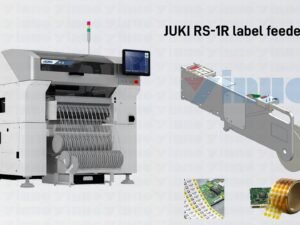


การแนะนำ
The Sheet Film Peeling Feeder is a specialized material-handling platform engineered for automated electronics assembly environments where sheet-form components must be bonded to a carrier tape in-line before downstream feeding and pick-and-place operations. Unlike conventional feeders that assume pre-bonded component-to-tape assemblies, this system performs the bonding process internally, transforming loosely stored sheet materials into a continuously indexed tape strip ready for sequential component retrieval.
The operational cycle begins with a vacuum suction cup retrieving a single sheet from the silo magazine. The sheet is transported to a defined placement position above the tape path — where a silent tape roll is loaded adhesive-side-up — and deposited onto the exposed tacky surface with controlled force. Immediately following deposition, a rubber-coated roller engages the sheet’s leading edge, applying directed downward pressure to press the sheet firmly into the adhesive layer, displacing trapped air and establishing uniform bonded contact.
Once bonding is complete, the feeder initiates tape feeding, advancing the bonded composite to the pickup position for nozzle retrieval. A defining architectural feature is its bidirectional feeding compatibility — supporting both forward-push and backward-retraction modes. This directional versatility allows the same feeder unit to serve mirrored production configurations without reconfiguration, simplifying line layout planning and reducing spare-feeder inventory requirements across diverse assembly line architectures.

เครื่องป้อนแบบลอกฟิล์มแผ่น
How Automotive Electronics Factories Utilize Sheet Film Peeling Feeders
Automotive electronics production lines handle a wide range of sheet-form materials that demand precise feeding. Battery management system boards require insulation films between cell monitoring layers. Motor control modules use thermal interface pads to manage heat dissipation from power transistors. LED driver circuits incorporate light-diffusing sheets that must be placed without scratches or static damage. Each of these materials presents a distinct handling challenge — varying in thickness, surface texture, and flexibility. The sheet film peeling feeder addresses this diversity by using an adhesive tape carrier system that secures each sheet through the entire transport cycle, from magazine extraction to final pickup.
Inside an automotive electronics factory, the feeder operates through a structured sequence. A roll of quiet adhesive tape is loaded with the sticky surface facing upward. The vacuum nozzle enters the magazine, extracts one sheet, and transfers it to the tape loading station. The sheet is laid onto the adhesive surface, and a wrapping roller immediately presses the leading edge, bonding the material firmly to the tape. This mechanical pressing eliminates air pockets and ensures the sheet remains flat without curling as the tape advances toward the peeling blade.
The feeder supports both front-pushing and rear-retracting peeling modes, allowing production engineers to match the peeling direction to material stiffness and placement head orientation. After the sheet is peeled and collected by the placement head, the spent tape winds onto the take-up reel while the nozzle returns to the magazine for the next cycle. This repeatable workflow suits high-mix automotive electronics lines where ECU boards, sensor modules, and body control units are assembled in rapid succession with minimal changeover downtime.

พารามิเตอร์
| รายการ | Parameter | รายการ | Parameter |
| วิธีการให้อาหาร | ปอกลงบนพื้นผิวกันติด แล้วหยิบขึ้น | แผงควบคุมการทำงาน | หน้าจอสัมผัส TFT ขนาด 3.5 นิ้ว, ความละเอียด 480×320 พิกเซล, แบบสัมผัสความจุ |
| Component Type | ชิ้นส่วนแบบแถบ (ต้องมีพื้นที่ว่างทั้งสองด้าน) |
ความเร็วในการให้อาหาร | การควบคุมความเร็วแบบไร้ขั้น, สูงสุด 100 มม./วินาที |
| Voltage | DC 24.0V | Power Consumption | <20W |
| ปัจจุบัน | 5.0A (สูงสุด) | Operating Temperature | -20~65°C |
| ความแม่นยำในการให้อาหาร | ±0.5 | ความชื้นในการทำงาน | 20~90%RH, ไม่เกิดการควบแน่น |
| การปรับตำแหน่งของเครื่องให้อาหาร | X: การปรับขีดจำกัดทางกล; Y: การปรับตั้งซอฟต์แวร์; Z: การปรับแต่งทางกล |
อุณหภูมิการเก็บรักษา | -40~85°C |
| ข้อมูลจำเพาะของระบบจ่ายอากาศ | 0.40–0.60 MPa | ความชื้นในการเก็บรักษา | 10~95% |
| อินเทอร์เฟซการสื่อสาร | ประเภท GPIO NPN/PNP | อายุการใช้งาน | ≥20,000 ชั่วโมง (25°C) |
| การสื่อสารของอุปกรณ์ฮาร์ดแวร์ | GPIO, RS232, TCP/IP | Dimensions | ตามข้อมูลจำเพาะของผลิตภัณฑ์ |
| วิธีการขับเคลื่อน | ไฟฟ้า + อากาศอัด | น้ำหนัก | ตามข้อมูลจำเพาะของผลิตภัณฑ์ |

https://www.youtube.com/@allaismt
For more information about the เครื่องป้อนแบบลอกฟิล์มแผ่น, โปรดส่งอีเมลไปที่
เราจะตอบข้อสอบถามของคุณอย่างรวดเร็วและให้ข้อมูลโดยละเอียดเกี่ยวกับผลิตภัณฑ์และบริการของเรา.