
Introdução
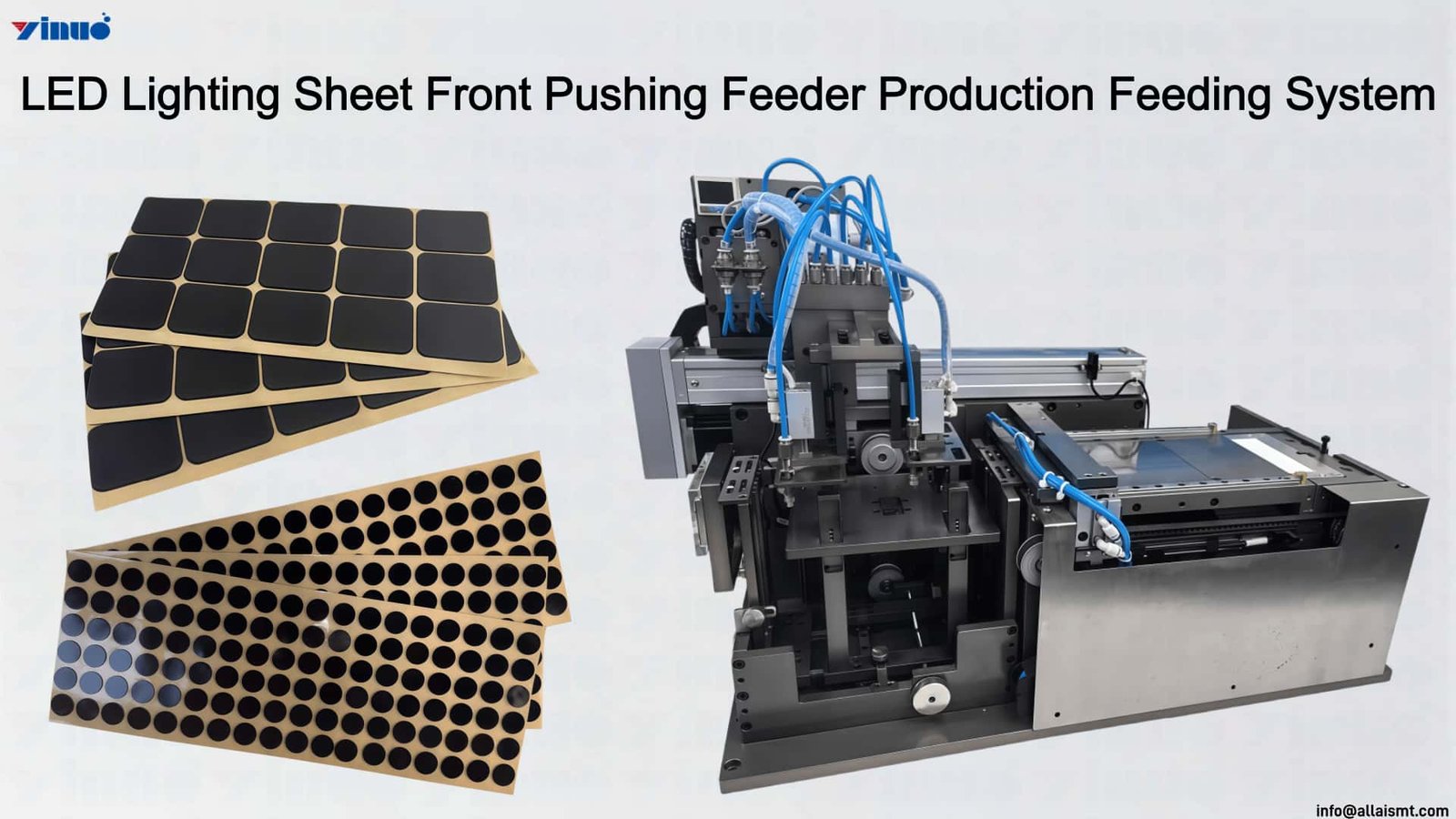
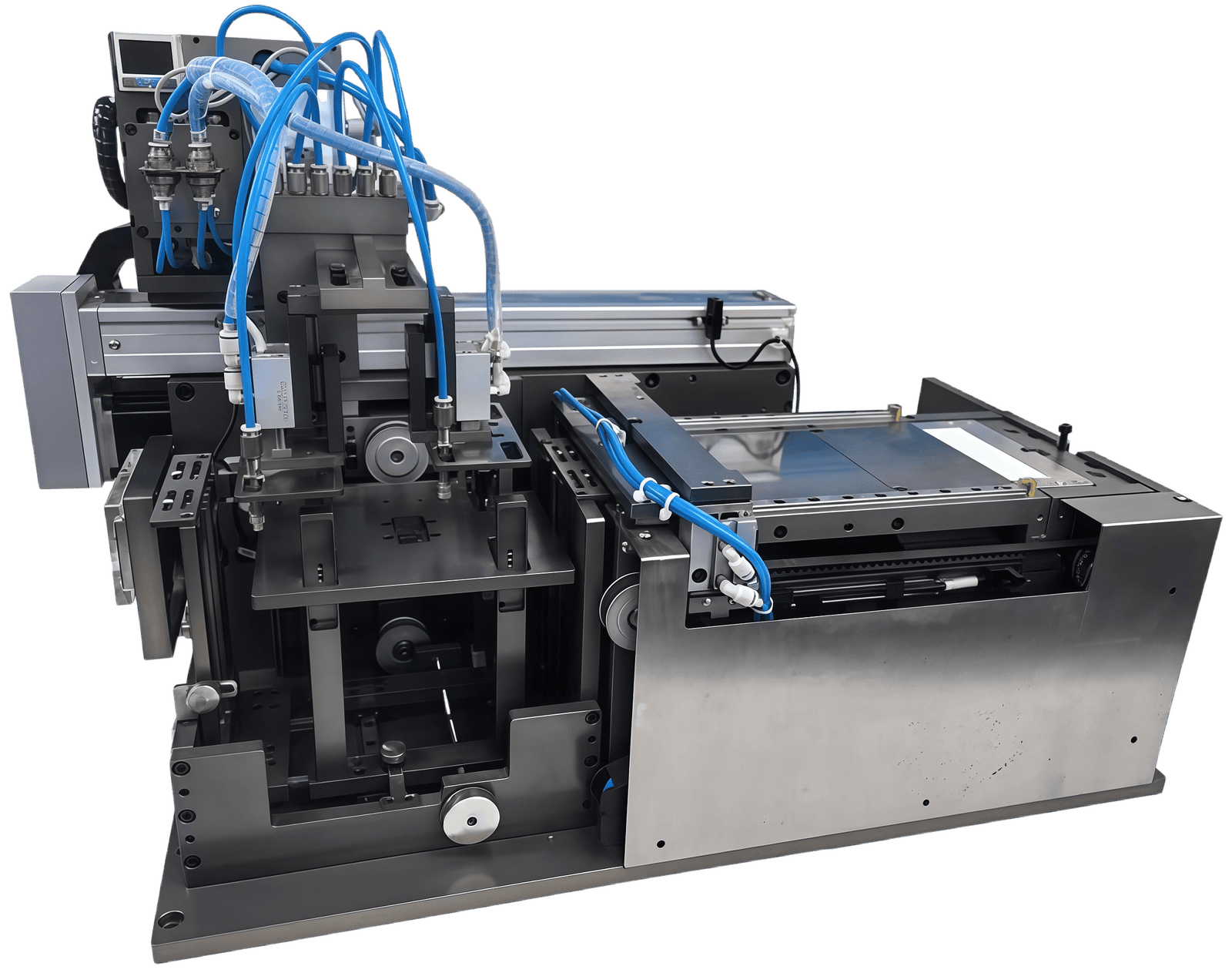
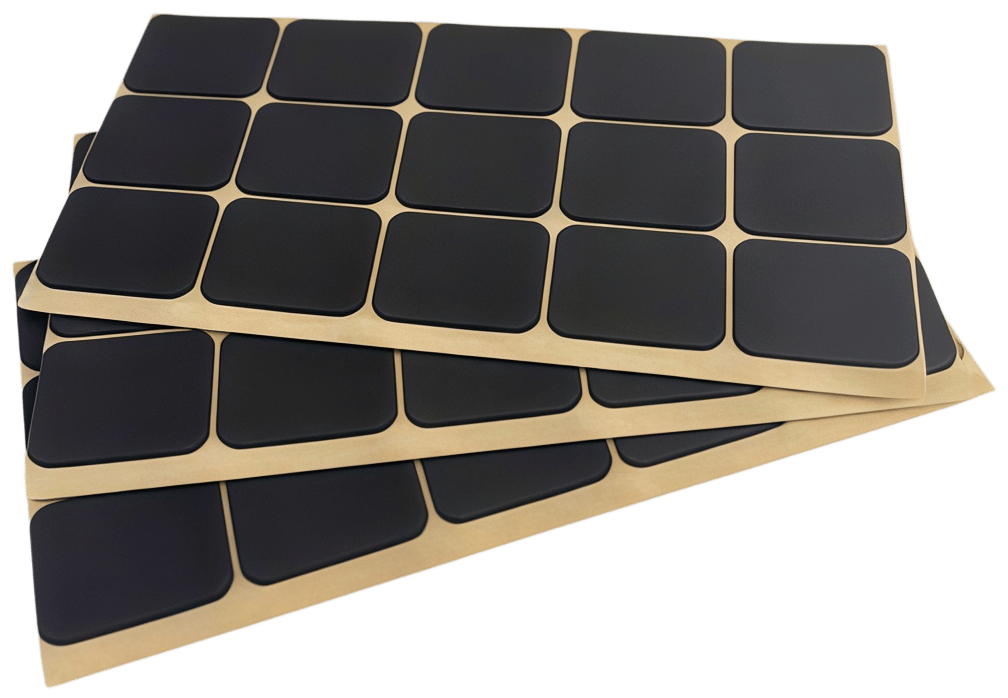
Sheet-form components — shielding covers, thermal pads, insulation films, conductive adhesive layers — are common across modern electronics assembly. Feeding these thin, often flexible materials requires a mechanism that controls position from pickup through delivery without introducing distortion. The Sheet Front Pushing Feeder achieves this through a structured four-stage sequence: magazine extraction, blade positioning, edge clamping, and forward feeding, all executed within a compact mechanical footprint.
The cycle starts with the vacuum nozzle descending into the magazine to retrieve one sheet. The sheet is transported to the peeling blade, where the pulling gripper secures the front blank edge and the pneumatic press block locks the rear edge. This simultaneous dual-end clamping forms a tensioned material bridge over the blade, preventing curling, sliding, or misalignment. The gripper then pulls the sheet forward to the target delivery position. After the placement head collects the material, the nozzle immediately returns to the magazine for the next extraction while the clamps reset — a parallel motion sequence that minimizes idle time between cycles.
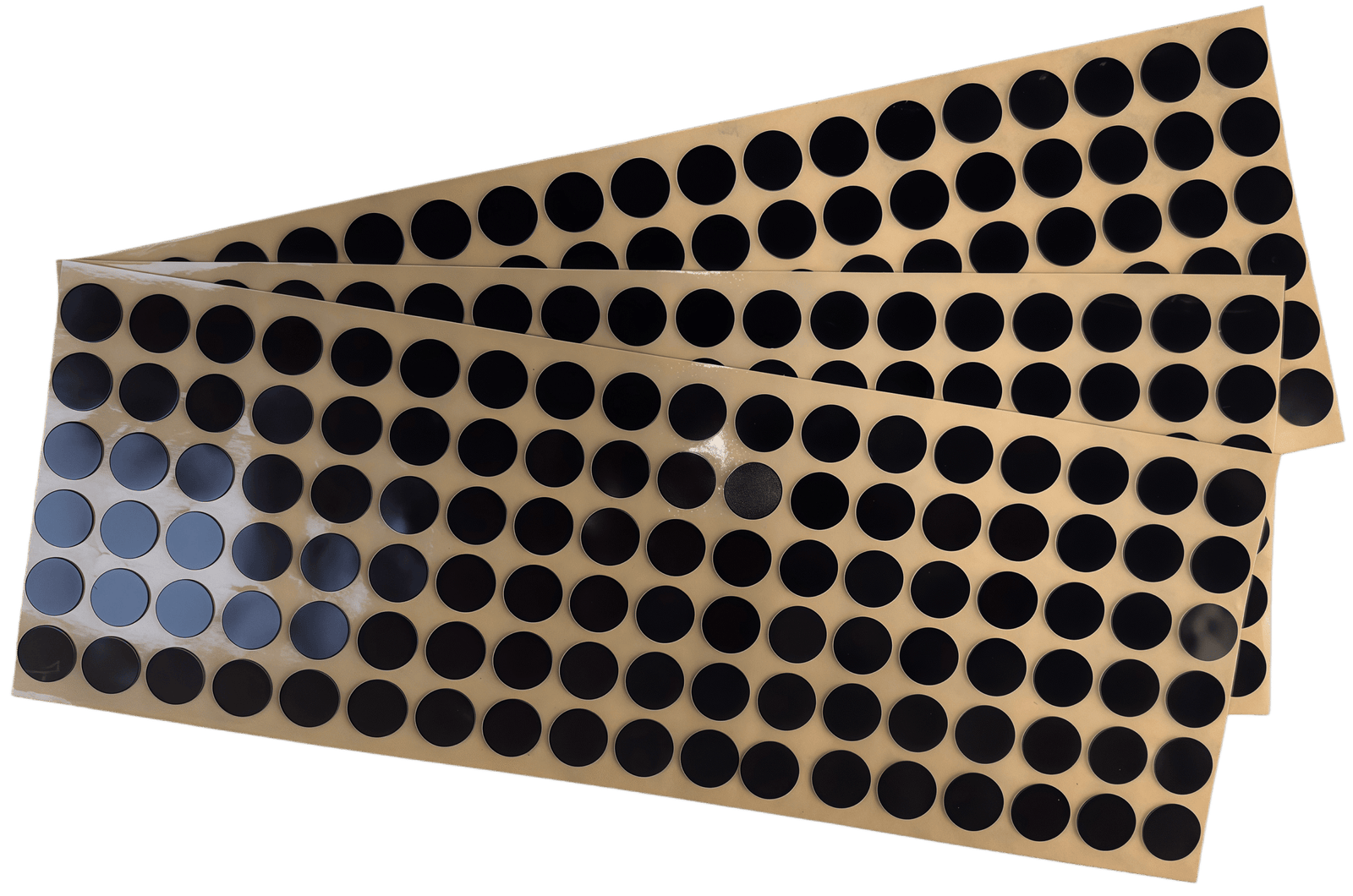
The feeder handles single-row and multi-row die-cut sheets of varying dimensions, adhesive properties, and edge profiles. Blade assemblies are field-changeable, supporting material size transitions without dedicated feeder units for each format. Feeding parameters — stroke, speed, and pitch — are programmable, allowing operators to store and recall material-specific profiles. Multi-row magazine configurations feed different sheet types from one station. This flexibility suits manufacturers producing LED driver boards, automotive lighting modules, display backlight assemblies, and industrial luminaire panels, where sheet materials differ between product lines and batch sizes shift frequently.
Sheet Front Pushing Feeder
Using Sheet Front-Pushing Feeders in LED Lighting Board Assembly
LED lighting assemblies incorporate a range of stress-sensitive sheet-form materials — thermal interface pads for heat dissipation, reflective optical films, diffusion sheets, and insulation layers — whose dimensional stability directly influences lumen output, color uniformity, and long-term reliability. The Sheet Front Pushing Feeder addresses these material handling requirements through its blank-zone clamping strategy, which engages the pull gripper exclusively on the leading non-functional margin and the press block on the trailing non-functional margin, applying zero mechanical contact to the component-bearing region during the entire feed cycle.
This non-contact preservation approach is particularly critical for optical-grade materials used in LED panel and downlight production. Reflective films and diffusion sheets exhibit high sensitivity to surface pressure, which can create micro-deformations that alter light distribution patterns and reduce fixture efficacy. The feeder’s pneumatic press cylinder applies calibrated downward force solely on the trailing blank area, preventing sheet lift during forward tape pull while preserving the optical surface integrity of the functional region. This dual-clamp stabilization eliminates the peel-induced curl and trailing-edge lift that destabilize component presentation in single-clamp feeding architectures.
The silo-magazine storage architecture further reinforces material quality by storing sheets in a relaxed, flat configuration rather than under continuous winding tension. For LED lighting factories handling large-format diffusion panels and thermal interface materials, this tension-free storage eliminates the telescoping and edge-wave deformation that plague reel-fed systems at production speed. The vacuum suction cup’s singulated extraction ensures one-sheet-per-cycle determinism, preventing multi-sheet pickup and static-cling adhesion — failure modes that cause placement voids and downstream rework on high-volume LED tube and bulb assembly lines.
Parâmetros
| Item | Parameter | Item | Parameter |
| Método de alimentação | Descole sobre a plataforma antiaderente e, em seguida, pegue | Painel de operação | Tela sensível ao toque TFT de 3,5 polegadas, 480×320 pixels, capacitiva |
| Component Type | Componentes de tira (é necessário deixar um espaço em branco nas duas extremidades) |
Velocidade de alimentação | Controle de velocidade contínuo, máx. 100 mm/s |
| Tensão | 24,0 V CC | Power Consumption | <20 W |
| Atual | 5,0 A MÁX. | Operating Temperature | -20 a 65 °C |
| Precisão na alimentação | ±0,5 | Umidade de operação | 20~90%RH, sem condensação |
| Ajuste da posição da alimentação | X: ajuste do limite mecânico; Y: ajuste de software; Z: ajuste mecânico |
Temperatura de armazenamento | -40 a 85 °C |
| Especificações de abastecimento de ar | 0,40~0,60 MPa | Umidade de armazenamento | 10~95% |
| Interface de comunicação | Tipo GPIO NPN/PNP | Vida útil | ≥20 mil horas (25 °C) |
| Comunicação de hardware | GPIO, RS232, TCP/IP | Dimensões | De acordo com as especificações do produto |
| Método de acionamento | Elétrico + Pneumático | Peso | De acordo com as especificações do produto |
https://www.youtube.com/@allaismt
For more information about the Sheet Front Pushing Feeder, Por favor, envie um e-mail para
Responderemos à sua solicitação prontamente e forneceremos informações detalhadas sobre nossos produtos e serviços.