

Wstęp
Where Does the PCB Go After Inspection?
After SMT assembly and inspection, completed PCBs need to leave the production line in an organized manner. Direct manual collection may require operators to retrieve boards individually, particularly when two production lanes are operating simultaneously. The YDU-250 Dual Rail PCB Unloader addresses this stage through a dual-lane conveying structure and magazine storage arrangement.
Step 1 – Receiving Boards from Upstream Equipment
The machine receives assembled PCBs through its designated conveyor paths. Its dual-rail structure accommodates two board transportation routes, making it suitable for production lines where separate PCB streams reach the same unloading area. The upstream conveyor height, transfer direction, and board dimensions should be checked during installation.
Step 2 – Positioning and Transfer
Once a PCB reaches the unloading section, the transfer mechanism moves the board toward its assigned magazine position. This stage requires appropriate alignment between the conveyor route and the magazine opening. Board thickness, edge clearance, and protruding components are important considerations when determining the machine’s operating configuration.
Step 3 – Magazine Collection
The magazine provides individual storage positions for assembled boards. As the unloading sequence proceeds, PCBs are arranged inside the magazine instead of accumulating at the conveyor exit. Once the collection process reaches the configured capacity, operators can retrieve the magazine and transfer it to the next workstation.
A Practical End-of-Line Arrangement
By combining dual-rail transportation with magazine collection, the YDU-250 establishes a defined discharge point for two PCB streams. Its application helps factories organize the final material-handling stage without treating each outgoing board as a separate manual collection task.
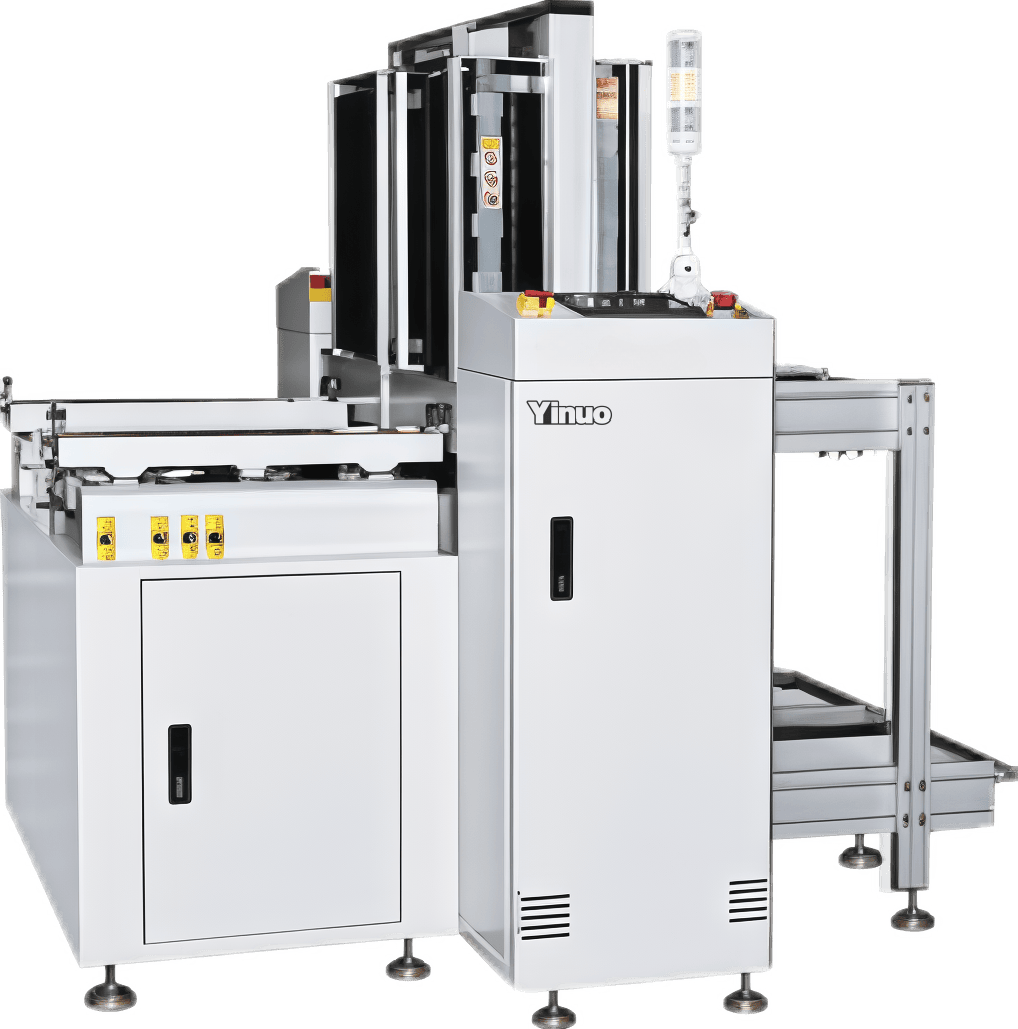
YDU-250 Dual Rail PCB Unloader
YDU-250 Magazine Unloader Accommodates Multiple PCB Categories Across Specialized Factory Operations
After Reflow Soldering and AOI Inspection
In a conventional SMT process, bare PCBs first pass through solder paste printing, component placement, and reflow soldering. AOI equipment then checks component presence, polarity, soldering conditions, and other inspection items. Once boards complete the required inspection procedures, the YDU-250 can be positioned at the end of the corresponding production route to collect assembled PCBs into magazines.
EMS Factories Handling Different Customer Orders
Contract electronics manufacturers frequently switch between PCB models according to customer schedules. Two production lanes may process different control boards or electronic modules during the same shift. In this situation, magazine collection offers a practical way to separate outgoing batches. Production staff can identify the collected magazines and transfer them to the appropriate testing or assembly department.
Power Supply and Energy Electronics
Manufacturers of switching power supplies, battery management systems, charging modules, and inverter control boards often require electrical verification after SMT assembly. The YDU-250 can collect these PCBs after the assembly stage, providing an organized transfer format before functional testing, voltage verification, or further component installation.
Server and Data Communication Hardware
Server motherboards, storage controller boards, and network communication circuits may pass through multiple inspection and assembly procedures. In production facilities using parallel SMT lanes, the unloader can receive boards from the corresponding conveyor paths. Magazine storage makes it easier to move assembled PCB batches to testing stations or system integration departments.

PCB Magazine Rack
Specyfikacje
| Model | YDU-250 | YDU-330 | YDU-390 | YDU-460 |
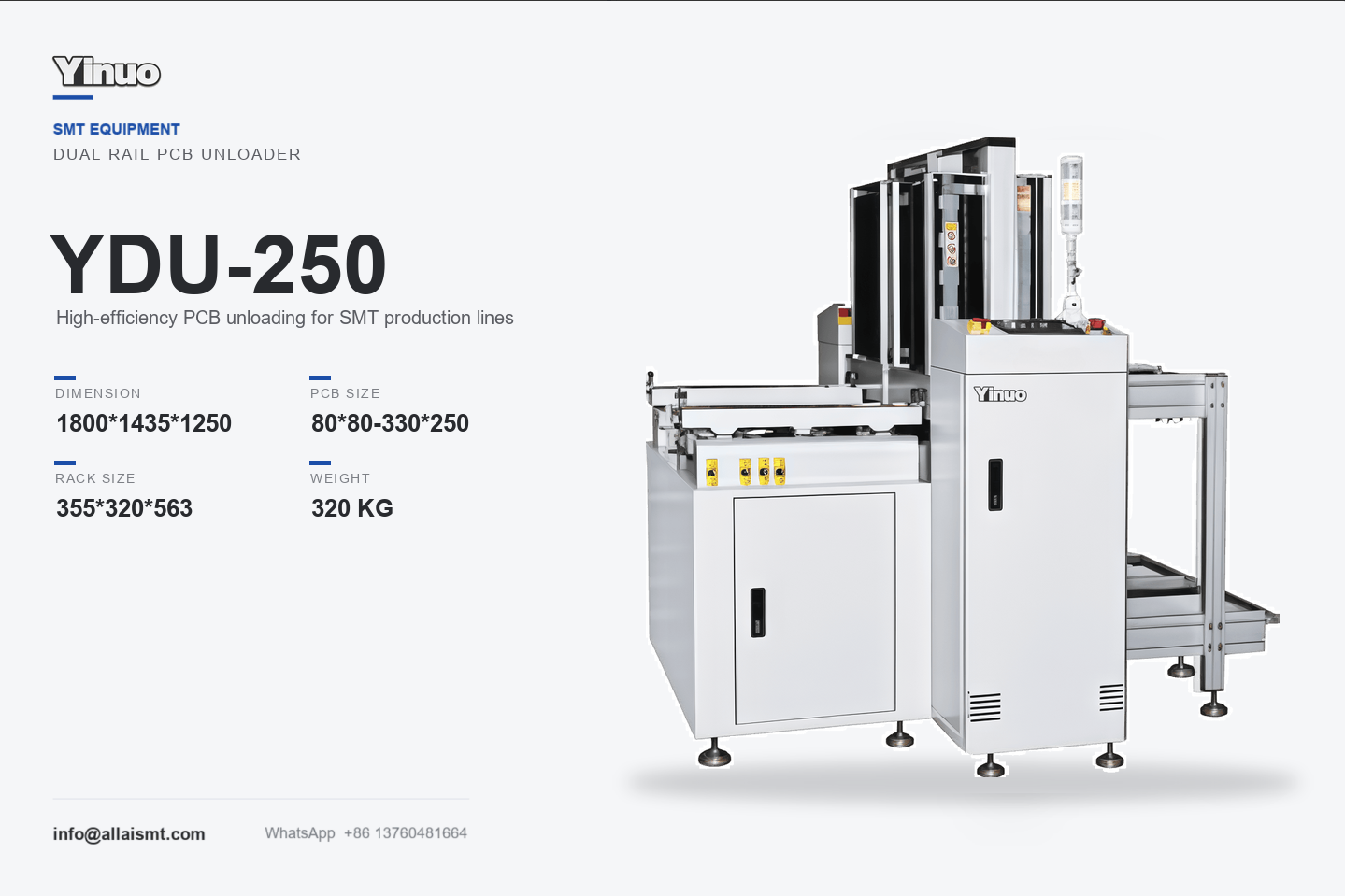
| Wymiary (mm) | 1800*1435*1250 | 2065*1690*1250 | 2330*1810*1250 | 2330*1950*1250 |
| Rozmiar płytki PCB (mm) | 80*80-330*250 | 80*80-445*330 | 80*80-530*390 | 80*80-530*460 |
| Rozmiar stojaka (mm) | 355*320*563 | 460*400*563 | 535*460*563 | 535*530*563 |
| Weight(KG) | 320 | 350 | 380 | 410 |
FQA
Q1: What is the main function of the YDU-250?
A: It collects assembled PCBs from dual conveying paths and transfers them into magazines for organized storage.
Q2: Can it collect PCBs after AOI inspection?
A: Yes. It can receive inspected boards before they move to subsequent testing or assembly operations.
Q3: Is it suitable for automotive PCB manufacturing?
A: Yes. It can collect automotive control boards, BMS circuits, and other assembled electronic PCBs.
Q4: What should be checked for boards with tall components?
A: Component height, loading orientation, and clearance throughout the transfer path should be evaluated.
Q5: What information is needed for machine layout planning?
A: Factory conveyor height, available floor space, upstream equipment position, and magazine handling requirements.
Firma Yinuo Electronics Co., Limited specjalizuje się w sprzęcie do montażu SMT i płytek drukowanych (PCB), oferując szeroki wachlarz rozwiązań dla branży produkcji elektronicznej. Nasza oferta produktowa obejmuje rozwiązania dla różnych etapów procesu produkcyjnego, pomagając producentom w doborze sprzętu dostosowanego do ich potrzeb operacyjnych. Naszym celem jest dostarczanie praktycznych produktów i profesjonalnego wsparcia klientom na całym świecie.
Nasza strona internetowa to: www.esmte.com | Contact email: info@allaismt.com | Video channel: https://www.youtube.com/@allaismt/videos | WhatsApp: +8613760481664


