

導入
In communication electronics manufacturing, sustained throughput depends on how reliably sheet-form materials are presented to the pick head. The Sheet Front Pushing Feeder optimizes this interface by combining silo-based storage, suction transfer, and tape-fed component delivery into one continuous, programmatically controlled workflow.
The feeding mechanism operates on a parallel-action principle. While the pull gripper secures the sheet’s front blank zone to initiate tape feeding, the press cylinder actuates a hold-down block onto the rear blank zone — stabilizing the sheet against lateral drift and peel forces. This dual-point clamping ensures that tape advancement remains precise even at elevated feed rates.
Cycle overlap further distinguishes the design. As soon as the gripper completes the feed stroke and the nozzle retrieves the component, the suction cup has already returned to the silo and engaged the next sheet. This overlapping retrieval minimizes dead time between cycles, enabling the sheet front pushing feeder to sustain high pick rates without compromising placement accuracy.
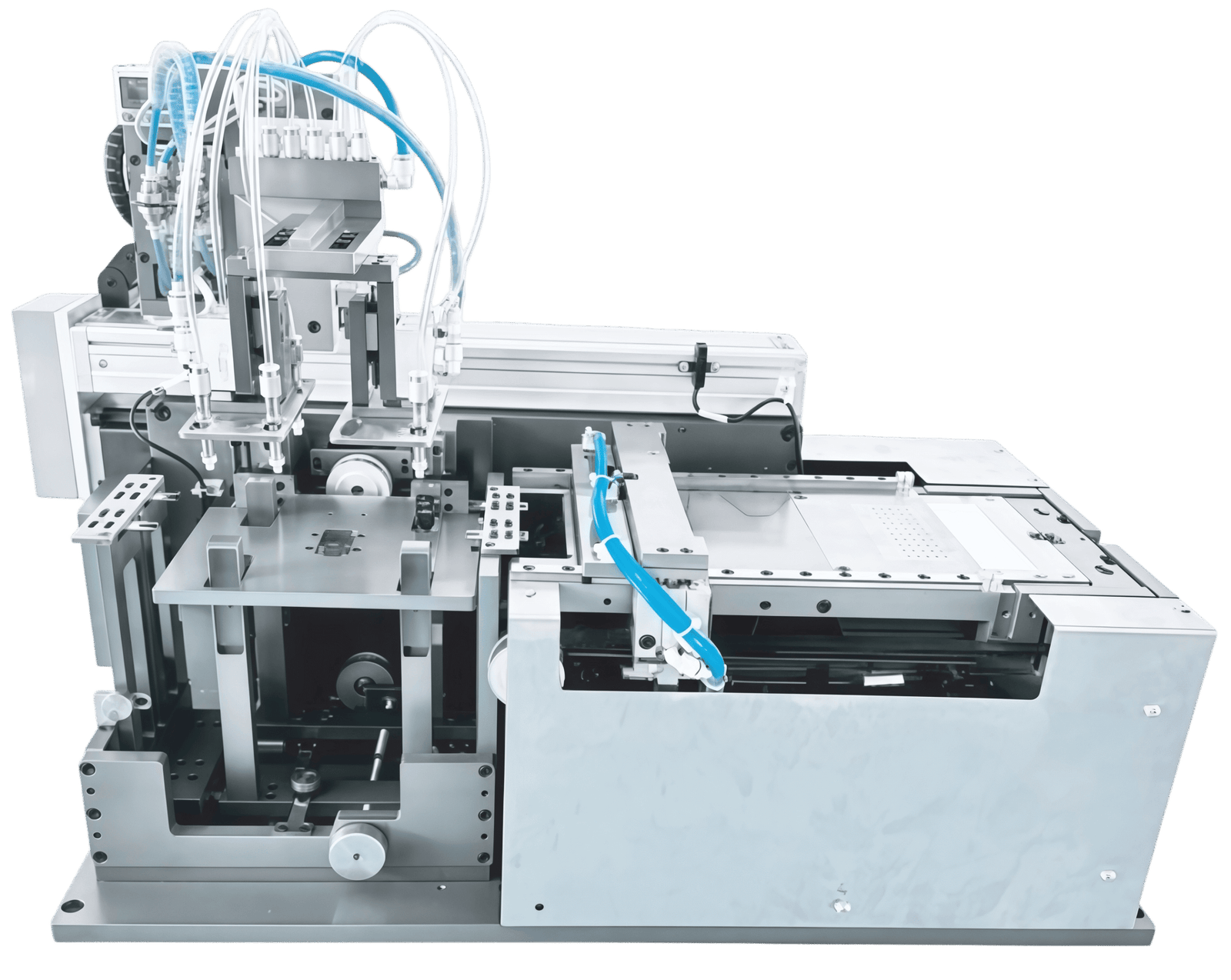
Sheet Front Pushing Feeder
Deploying Sheet Front Pushing Feeders in Telecom Electronics Manufacturing
In a communication electronics factory, the variety of sheet materials flowing through SMT lines is substantial. Shielding covers for RF modules, thermal gap pads for power amplifiers, insulation sheets for high-speed backplanes — each demands careful handling to avoid wrinkles, static buildup, or positional drift. The Sheet Front Pushing Feeder fits into this environment by offering a self-contained material handling loop that starts at the magazine and ends at the placement pickup zone, with every step mechanically coordinated to preserve sheet integrity.
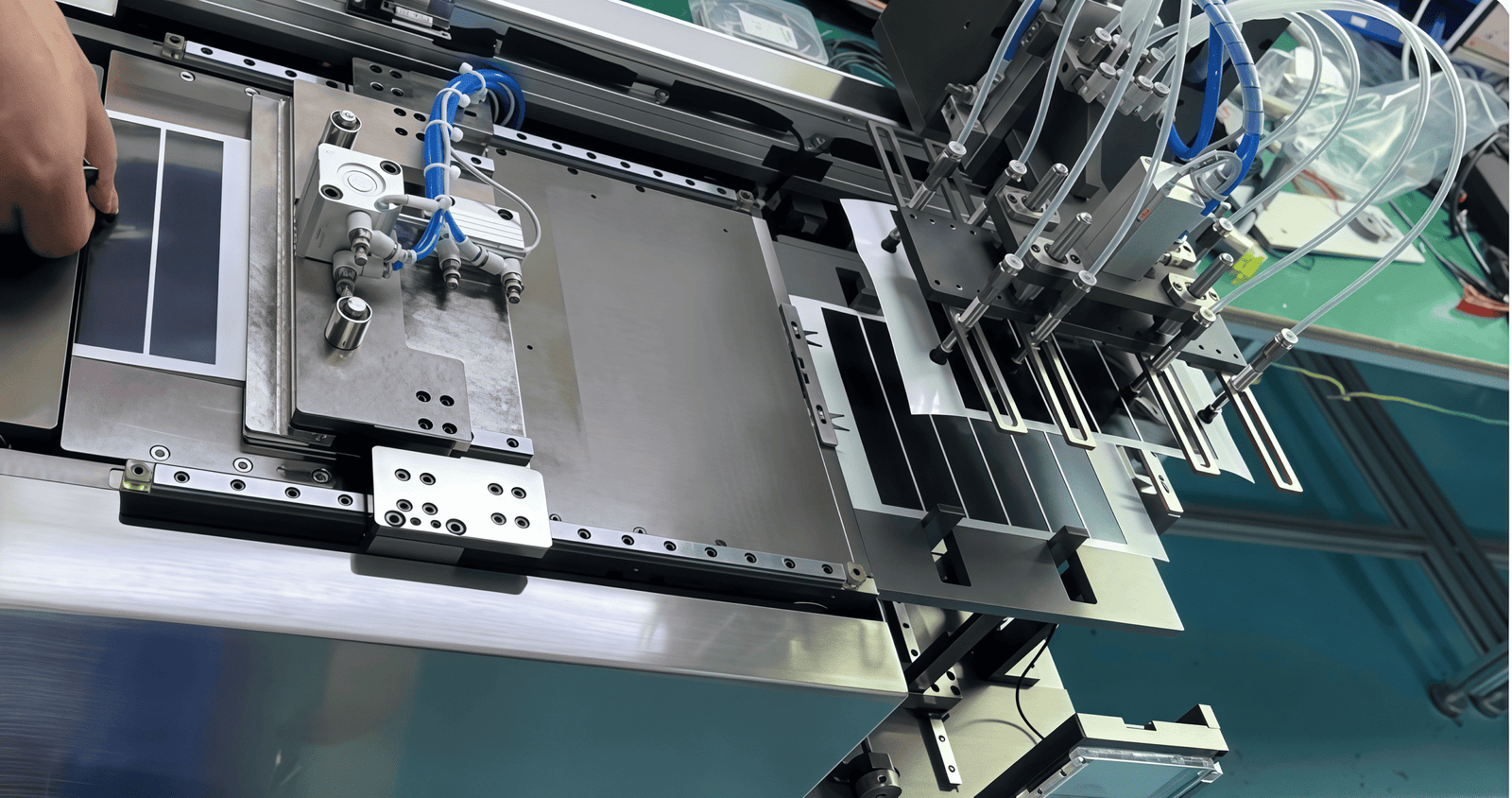
The feeding cycle begins with the suction nozzle entering the magazine to lift one sheet from the top of the stack. The sheet is transported to the peeling blade area, where two clamping actions occur simultaneously: a pulling gripper secures the front blank edge, and a press block controlled by a pneumatic cylinder engages the rear blank edge. This dual-point grip holds the sheet flat and centered over the blade, preventing any lateral movement or curling that would compromise placement precision. The gripper then advances the sheet forward in a controlled motion, delivering it to the defined pickup coordinate.
After the placement head collects the material, the nozzle cycles back to the magazine to retrieve the next sheet, while the gripper and press block reset to their home positions. This repeating rhythm suits the throughput requirements of communication equipment assembly lines, where boards for small cell base stations, datacom switches, and optical transport modules are built in rapid succession. Because the feeder handles sheets of varying thickness and surface texture without recalibration, operators can switch between material types with minimal downtime. For telecom manufacturers aiming to reduce manual sheet loading and improve placement repeatability, this feeding approach offers a practical, line-ready solution.
パラメータ
| アイテム | Parameter | アイテム | Parameter |
| 給餌方法 | 非粘着プラットフォームの上に皮をむき、その後、取り出す | Operation Panel | 3.5インチTFTタッチスクリーン、480×320ピクセル、静電容量式 |
| Component Type | コンポーネントの分解 (両端に空白領域が必要です) |
供給速度 | 無段階速度制御、最大100mm/s |
| 電圧 | DC 24.0V | Power Consumption | <20W |
| 現在 | 最大5.0A | Operating Temperature | -20~65°C |
| 給餌精度 | ±0.5 | 動作湿度 | 20~90%RH、結露なし |
| フィード位置の調整 | X:機械的限界の調整;; Y:ソフトウェア調整;; Z:機械的な調整 |
保管温度 | -40~85°C |
| エア・サプライの仕様 | 0.40~0.60 MPa | 保管時の湿度 | 10~95% |
| 通信インターフェース | GPIOのNPN/PNPタイプ | 耐用年数 | 20,000時間以上(25°C) |
| ハードウェア通信 | GPIO、RS232、TCP/IP | 寸法 | 製品仕様書に基づき |
| 駆動方式 | 電気式+空気圧式 | 重さ | 製品仕様書に基づき |

https://www.youtube.com/@allaismt
For more information about the Sheet Front Pushing Feeder, 、メールをお送りください
お問い合わせには速やかに対応し、弊社製品およびサービスに関する詳しい情報を提供させていただきます。.