

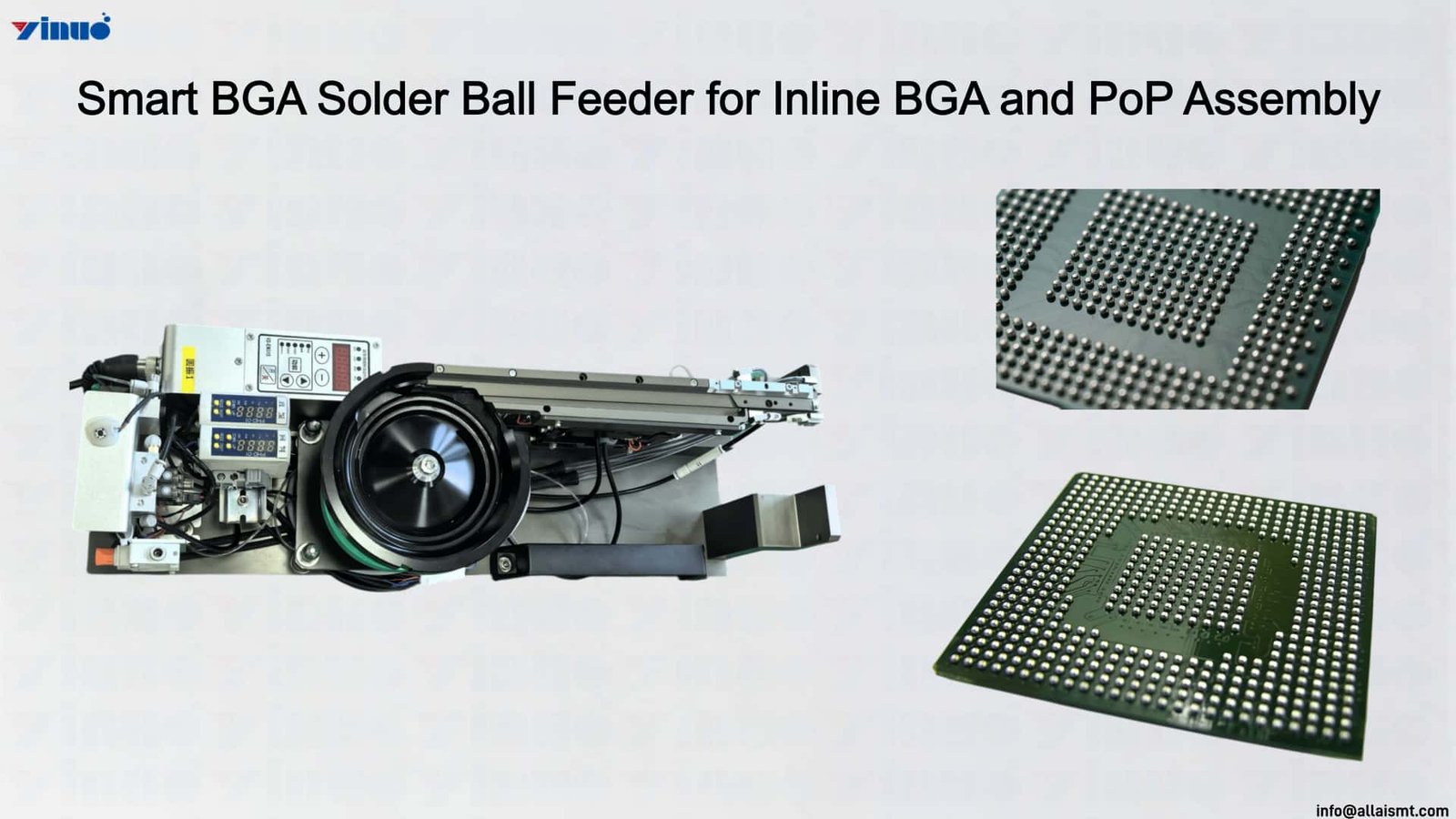
Smart BGA Solder Ball Feeder for Inline BGA and PoP Assembly
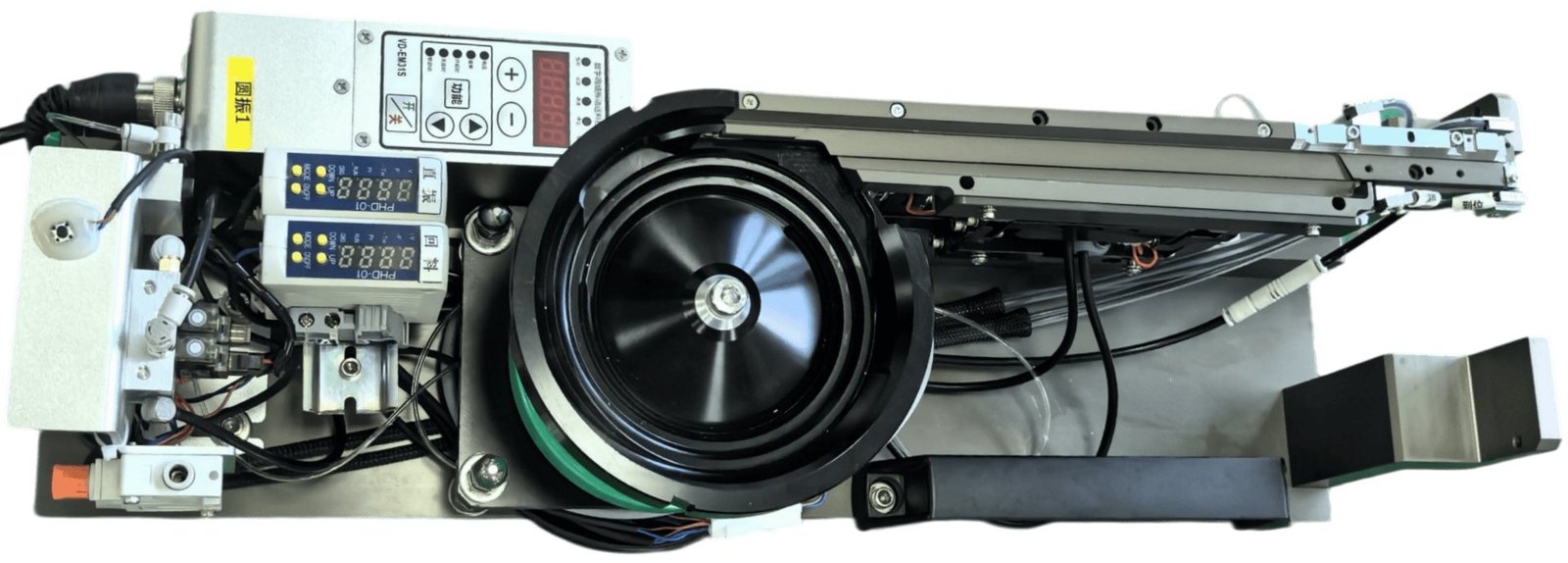
IL BGA Solder Ball Feeder carries one job through the whole line: turn a bottle of loose spheres into a repeatable, single-file stream that a placement head can pick without hesitation. Automated solder ball feeding at this level means the feeder does not merely drop balls into a track. It separates, orients, and presents each sphere at a fixed point the machine already knows, so ball attach runs inline with normal component placement. BGA solder ball feeder configurations cover both true solder balls and inert micro spacer balls on the same platform.
Feeding Performance and Material Delivery
Continuous solder ball delivery starts with a bowl or carrier that never lets the stream break. Bulk spheres enter the reservoir, and the track converts that loose pile into sequential solder ball feeding at a rate the head can follow — controlled solder ball feeding rather than a gravity dump. Individual solder ball delivery is the visible result: one sphere at the pick window, every cycle, with stable solder ball delivery maintained across long production runs. Uniform sphere distribution along the track keeps the nozzle from meeting a gap or a cluster, and automated solder ball separation handles the tangles that form whenever spheres of the same diameter sit in contact. Controlled ball release at the exit completes the sequence: the ball leaves the track only when the nozzle is in position, which is what targeted solder ball presentation actually requires.
Separation, Arrangement, and Pickup Positioning
Small spheres roll. They overlap, pile into clusters, and settle into gaps in the track. Fine solder ball separation answers that behaviour directly, and solder ball singulation finishes the job so only one sphere reaches the pickup aperture at a time. Automated sphere arrangement and solder ball orientation work together here: the track geometry turns random entry into an ordered queue, so overlapping sphere separation resolves before the nozzle arrives rather than after a missed pick. Repeatable pickup positioning matters more than raw speed, because a placement program cannot compensate for a ball that sits outside the taught point. Accurate pickup position control, micro sphere positioning and feeding for the smallest diameters, and organized pickup point presentation all serve the same goal — automated ball pickup preparation that the machine can schedule like any other feeder, with a feeder ID and a fixed pick coordinate.
Ball Diameter Compatibility and Material Range
Multi-diameter compatibility is built from matched hardware, not software settings. Bowl models cover 200 to 800 µm at 8 to 40 balls per minute. The micro model uses a ball-on-plate carrier for 75 to 150 µm, including the 130 µm class, at 4 to 8 balls per minute with vision counting — fine-diameter solder ball feeding where gravity stops being the dominant force and electrostatic attraction, surface adhesion, and oxide build-up take over. Micro spacer ball feeding uses the same principle: one sphere per pocket by geometry rather than by tuning. Configurable ball diameter feeding comes from diameter-specific feeding configuration, where the track, carrier, and nozzle set are machined as one matched group. Multi-type sphere handling covers solder balls and spacer balls alike, so solder ball and spacer ball compatibility does not require a second machine, and adaptation to different packaging specifications — 0.25 mm and 0.3 mm pitch included — fits one flexible sphere feeding solution. Below 300 µm the feeder runs under a nitrogen blanket, because an oxidised sphere will not wet, and that shows up as insufficient solder long after placement looks perfect.
Automation and Production Line Integration
Automated ball attach equipment integration is the point of the design. The feeder mounts to a side station bracket beside the feeder rail, registers with a feeder ID, and hands the placement program a fixed pick position, which is how pick-and-place compatible feeding works without custom software. SMT production line feeding and automated semiconductor packaging feeding share the same interface, so ball attachment and feeding coordination happen inside the existing program: production cycle-synchronized feeding means the bowl refills during placement instead of pausing it. BGA and PoP packaging feeding both run from the same station, automated material transfer coordination keeps upstream and downstream handling continuous, and continuous ball attachment material supply removes the batch logic that dedicated ball attach machines impose. Primary engineering target is ASM / ASMPT SIPLACE — X series, SX, TX and HM. Alimentatore personalizzato SMT adaptors are also built for YAMAHA, FUJI, PANASONIC, JUKI and SAMSUNG platforms, each with its own bracket, its own pick position, and a head clearance check at full gantry travel.
Changeover and Operating Efficiency
Rapid solder ball changeover depends on how the components are grouped. Quick-exchange feeding components release as a matched set, so simplified ball diameter conversion takes one swap rather than a re-alignment. Reduced manual material handling follows from sealed reservoir loading and automated material replenishment, which together deliver extended feeding intervals and reduced operator intervention during a shift. Efficient material management shows up as fewer stoppages, and reduced feeding interruptions protect the placement program from re-teaching after every refill. When the product mix changes, flexible production changeover keeps the feeder in the line instead of on the bench.
Application Production Lines
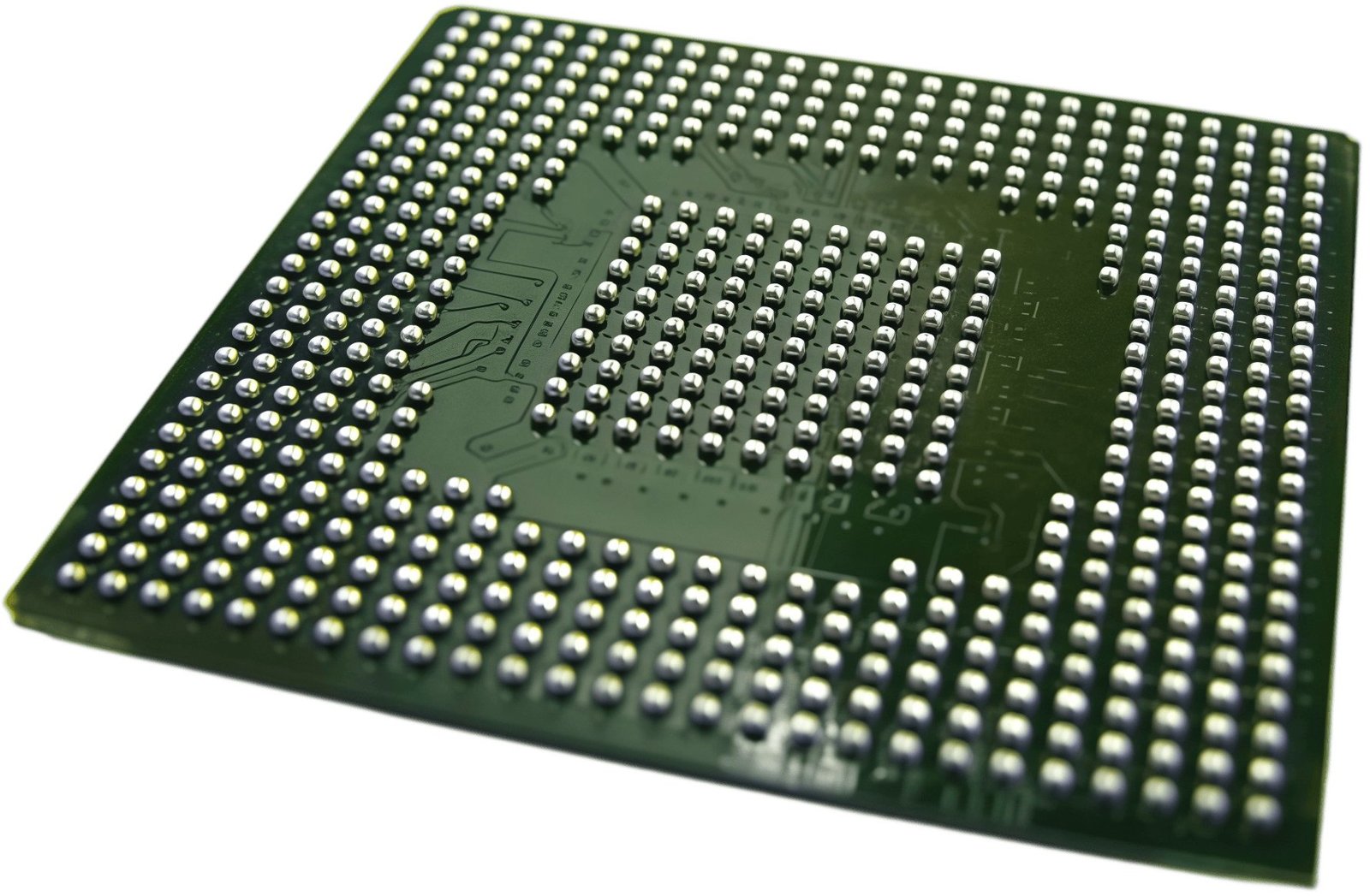
- BGA packaging and ball-attach lines — ball insertion for ball-grid-array packaging, where the feeder delivers spheres one by one so the placement equipment maps every ball to its pad. Serves chip packaging, substrate manufacturing, and post-package processing.
- PoP packaging and stack assembly lines — interconnect balls and micro spacer balls for Package-on-Package stacking, where the top package’s ball array connects down onto the logic package. Suitable for mobile processors, memory packages, and compact computing modules.
- Wafer-level and advanced packaging lines — ball placement for WLP, fan-in and fan-out structures, with matched feeding for micro ball diameters and dense pad arrays.
- BGA rework and re-balling lines — ordered ball supply for re-attaching balls after desoldering, package remanufacturing, and rework, giving EMS providers and dedicated rework factories an organized way to restore components.
- Memory and high-performance computing packaging lines — ball-grid interconnect for DRAM, NAND, and HBM related packaging and HPC module manufacturing, including die stacking and substrate assembly.
- Automotive and industrial control electronics lines — automotive ECU, power control modules, industrial controllers, and communication equipment built with BGA devices, where ball feeding serves the ball-attach and rework steps rather than standard PCB placement.
Process Notes
For SAC305, reflow peak is 235–245 °C with 60–90 seconds above the 217 °C liquidus. For the smallest balls, pure tin Sn99.99 is preferred, because low-residue paste with coarser powder leaves too much residue on a sphere that small. Verify the result with X-ray; voiding above 25% per ball joint is the usual reject limit.
Why Yinuo
Yinuo builds each feeder around the customer’s real ball stock. We profile a sample of your spheres, machine the track or carrier to match, and run 2 to 4 hours of flow verification on the target machine model before dispatch. Every unit is tested on-machine and recorded on video, so you watch your own balls run through your own machine before the feeder leaves our floor. Adaptor bracket, matched ball-pick nozzles, and placement program template ship as one working package, and our engineering team checks head clearance at full gantry travel for every platform. As a manufacturer focused on SMT feeding equipment, Yinuo supports electronics and semiconductor packaging lines worldwide with practical hardware and direct technical assistance.
What We Need to Quote
Ball diameter, alloy (SAC305 / SAC405 / Sn99.99 / low-melt), whether the spheres are true solder balls or inert spacers, target pitch, board size, machine model, and annual volume. Send a sample of your actual ball stock if you can. We profile it, machine the track or carrier to match, and run flow verification before shipping. Tell us your ball diameter and pitch, and we will confirm which architecture your application actually needs — including when the honest answer is a dedicated ball attach machine rather than a feeder.
Yinuo Electronics Co., Limited specializes in SMT and PCB assembly equipment, offering a range of solutions for electronics manufacturing. Our product portfolio supports different stages of the production process, helping manufacturers select suitable equipment for their operational needs. We are committed to providing practical products and professional assistance to customers worldwide.
Our website is: www.esmte.com | Contact email: info@allaismt.com | Video channel: https://www.youtube.com/@allaismt/videos | WhatsApp: +8613760481664