

Introducción
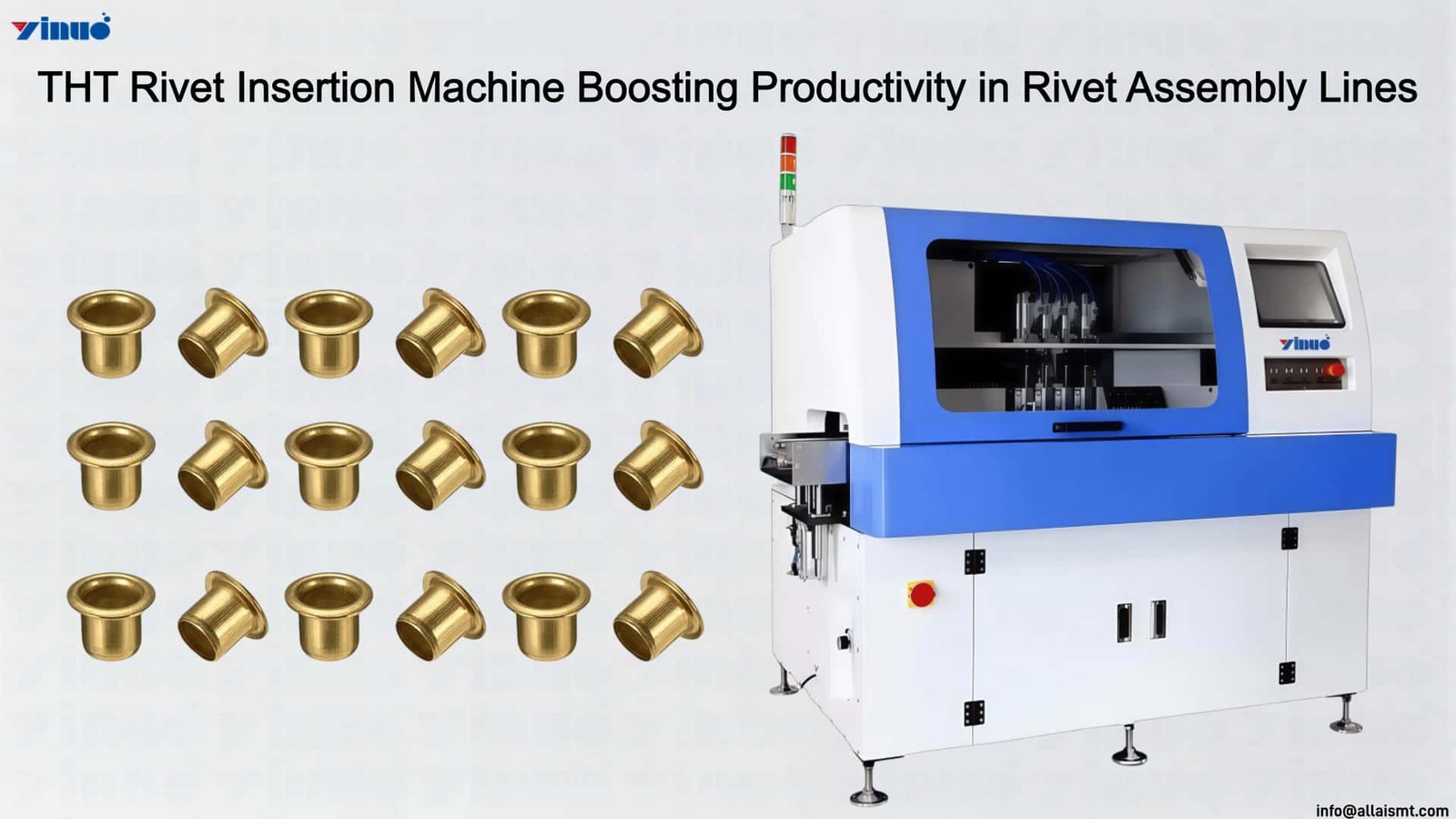
El THT Rivet Insertion Machine performs automated feeding, positioning, insertion, and verification of through-hole rivets on PCB assemblies. Designed to replace manual riveting stations, the system uses a servo-actuated insertion head to apply controlled force and depth for each cycle. Rivets are delivered through a vibratory feeding system with optical orientation checking, ensuring correctly aligned fasteners reach the insertion point. The machine supports programmable job storage, allowing operators to recall settings for different board types and rivet specifications without recalibration. Real-time insertion monitoring detects out-of-spec results and alerts operators, helping prevent defective boards from advancing downstream.
Tooling changeover is handled through quick-release cassettes that accommodate different rivet diameters without requiring specialized tools or extended setup time. This modular approach suits production environments where multiple product variants run on the same line. The system can be configured with single or dual insertion heads depending on throughput requirements and board complexity. An onboard diagnostic module tracks cycle counts, insertion force profiles, and component wear trends. This data supports both preventive maintenance scheduling and customer audit documentation, providing objective evidence of process stability.
From a production economics perspective, the THT Rivet Insertion Machine reduces direct labor allocation for rivet placement while improving insertion uniformity compared to manual methods. One operator can supervise multiple machines, lowering per-board labor cost. The consistent insertion quality also reduces rework rates and field failure risk tied to poor rivet seating or substrate damage. For EMS providers and OEMs supplying automotive, telecom, and industrial electronics markets, documented process control is increasingly a prerequisite for supplier qualification. The machine’s logging and verification functions produce the traceability records these customers expect, giving manufacturers a practical tool for meeting both productivity targets and compliance requirements.

THT Rivet Insertion Machine
How the THT Rivet Insertion Machine Utilizes Rivets
The role of rivets in through-hole assembly is crucial, as they provide both structural support and electrical continuity. The THT Rivet Insertion Machine is engineered to optimize this process through advanced automation and precision control. Each rivet insertion is treated as a unique event, with tailored parameters set for insertion velocity, force, and duration based on the specific rivet type. This not only enhances the accuracy of each insertion but also ensures that the rivets are securely anchored, capable of withstanding the rigors of thermal and mechanical stress over time.
Rivet feeding plays a pivotal role in the efficiency of the insertion process. The THT Rivet Insertion Machine employs a sophisticated feeding system that utilizes mechanical sorting and air-assist technology to orient rivets without damaging their surfaces. This meticulous handling is essential for maintaining the integrity of the rivet plating, which directly affects solderability during subsequent assembly stages. Additionally, a fiber-optic sensor confirms the correct orientation of each rivet before insertion, preventing costly errors that could lead to assembly failures and increased rework.
From a quality assurance standpoint, the THT Rivet Insertion Machine delivers measurable benefits that enhance operational efficiency. By logging each insertion cycle and maintaining comprehensive records, manufacturers can demonstrate compliance with industry standards and client specifications. This capability not only reduces internal rework costs but also strengthens supplier qualifications. For electronic manufacturers, where precision and reliability are paramount, the ability to provide documented evidence of controlled rivet insertion elevates their market position and builds confidence with clients.

Remaches para placas de circuito impreso
Presupuesto
| Modelo | YT-7000 |
| Dimensiones totales | 2080 mm (largo) × 1230 mm (ancho) × 1600 mm (alto) |
| Peso | 1 000 kg |
| Aire | 6 ± 0,5 kg/cm² (consumo de aire: 656 N/min) |
| Fuerza | 220 V CA, monofásica, 50/60 Hz, 1,4 kW |
| Ruido | 80 dB |
| Operating Environment | 5-40 u |
| Humedad | 10-90%RH (se puede utilizar siempre que no haya partículas de cristal en el aire) |
| Requisitos relativos al entorno | Sin gases corrosivos |
| Dimensión de desplazamiento del banco de trabajo | X 680 mm, Y 370 mm multidireccional; X 580 mm, Y 370 mm bilateral |
| Velocidad de desplazamiento del banco de trabajo | 22,5 m/min |
| Placa de circuito impreso (PCB) | 490 × 350 (máx.) |
| Velocidad de taponado | 200 unidades/min |
| Tiempo de instalación de la placa de circuitos eléctricos | 4s |
| Componente insertado | Remaches comunes de 1,6-3,5 mm, remaches largos y remaches Lacerivet |
| Cantidad de tapones | 3 cabezales |
| Modo de corrección de agujeros | Según el sistema angular de la máquina |
| Sistema de control informático | Sistema operativo Windows |
| Sistema de visualización | Pantalla LCD en color de 17 pulgadas |
| Sistema de alimentación | Sistema de alimentación vibratorio de gran tamaño |
https://www.youtube.com/@allaismt
For more information about the THT Rivet Insertion Machine, por favor envíe un correo electrónico a
Responderemos a su consulta a la brevedad y le proporcionaremos información detallada sobre nuestros productos y servicios.
-300x225.jpg)
-300x225.jpg)
-300x225.jpg)