

Einführung
For SMT equipment integrators, the PCB Flip Machine represents a functional link between board transport architecture and process accessibility. Its purpose is to change the exposed PCB surface when the manufacturing sequence requires a different orientation, allowing the surrounding production equipment to retain its assigned processing function. This capability can be relevant to automotive electronic control units, industrial power supplies, communication hardware, and smart appliance control boards, where component arrangements and assembly sequences vary according to the finished product. The inversion function gives line planners another option when determining how boards should be routed through successive workstations.
Equipment layout has a direct influence on the machine’s practical performance. The incoming conveyor must deliver the PCB in a suitable position, and the receiving station must be able to accept the board after inversion. Differences in conveyor elevation, transfer direction, available floor space, and neighboring machine interfaces can affect the installation arrangement. Engineers should also assess the clearance required for the inversion mechanism to complete its movement without contacting surrounding structures. Addressing these interface conditions during line design helps prevent avoidable layout modifications after equipment installation and makes the transfer sequence easier to define.
The PCB Flip Machine can also contribute to more systematic production control by assigning board inversion to a dedicated machine rather than relying on individual operator procedures. Where supported by the control configuration, PLC sequencing and sensor feedback coordinate the machine’s actions with the board-handling cycle. A torque limiter may provide a mechanical response to abnormal resistance, depending on the equipment design, while selectable operating modes can accommodate different routing instructions. These functions should be assessed against the actual production specification rather than assumed to be identical across all models. With suitable interface planning and board compatibility checks, the machine provides SMT manufacturers with a specialized approach to orientation management, equipment coordination, and automated material handling.
PCB Flip Machine
PLC Controlled PCB Flip Machine for Battery Electronics Line Automation
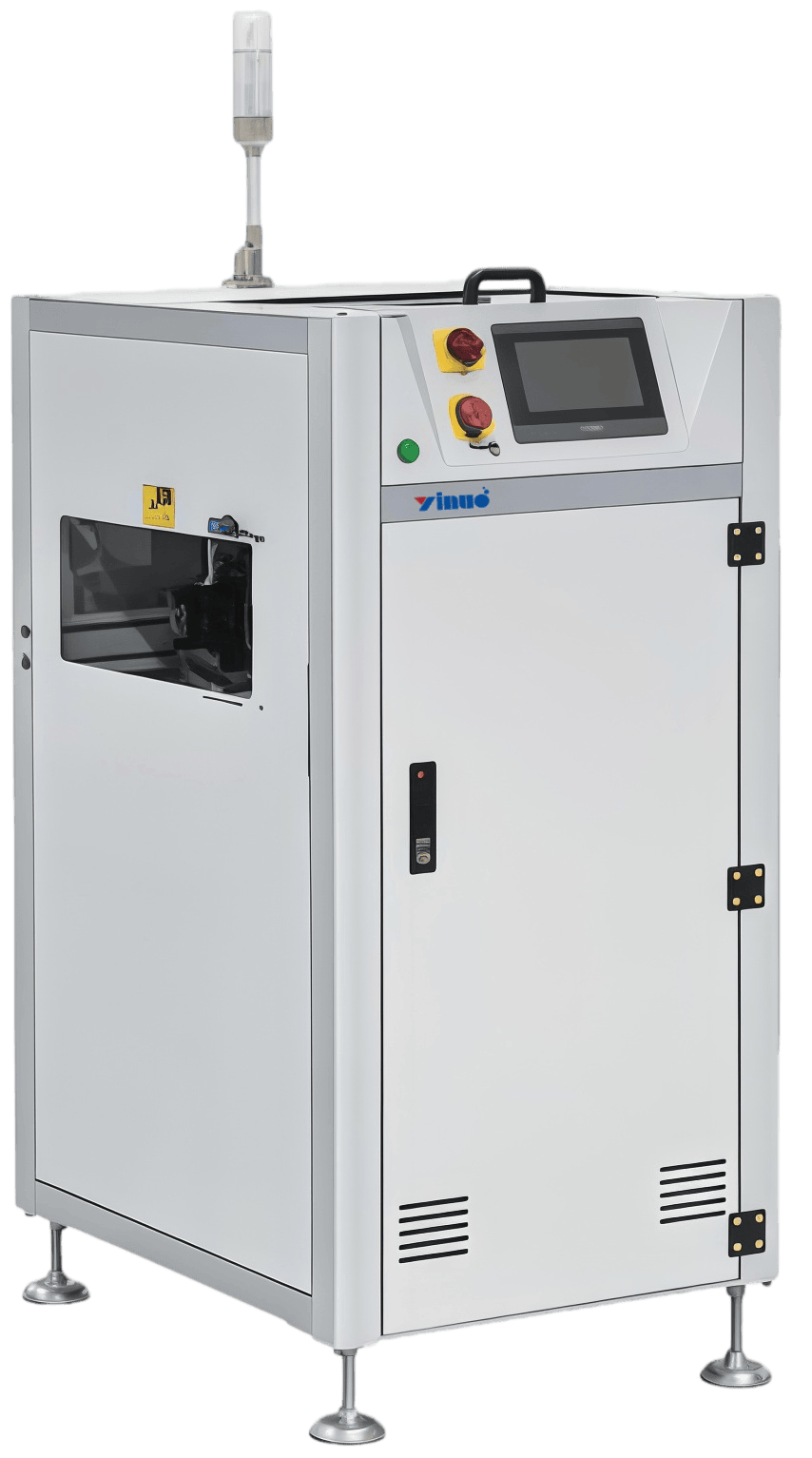
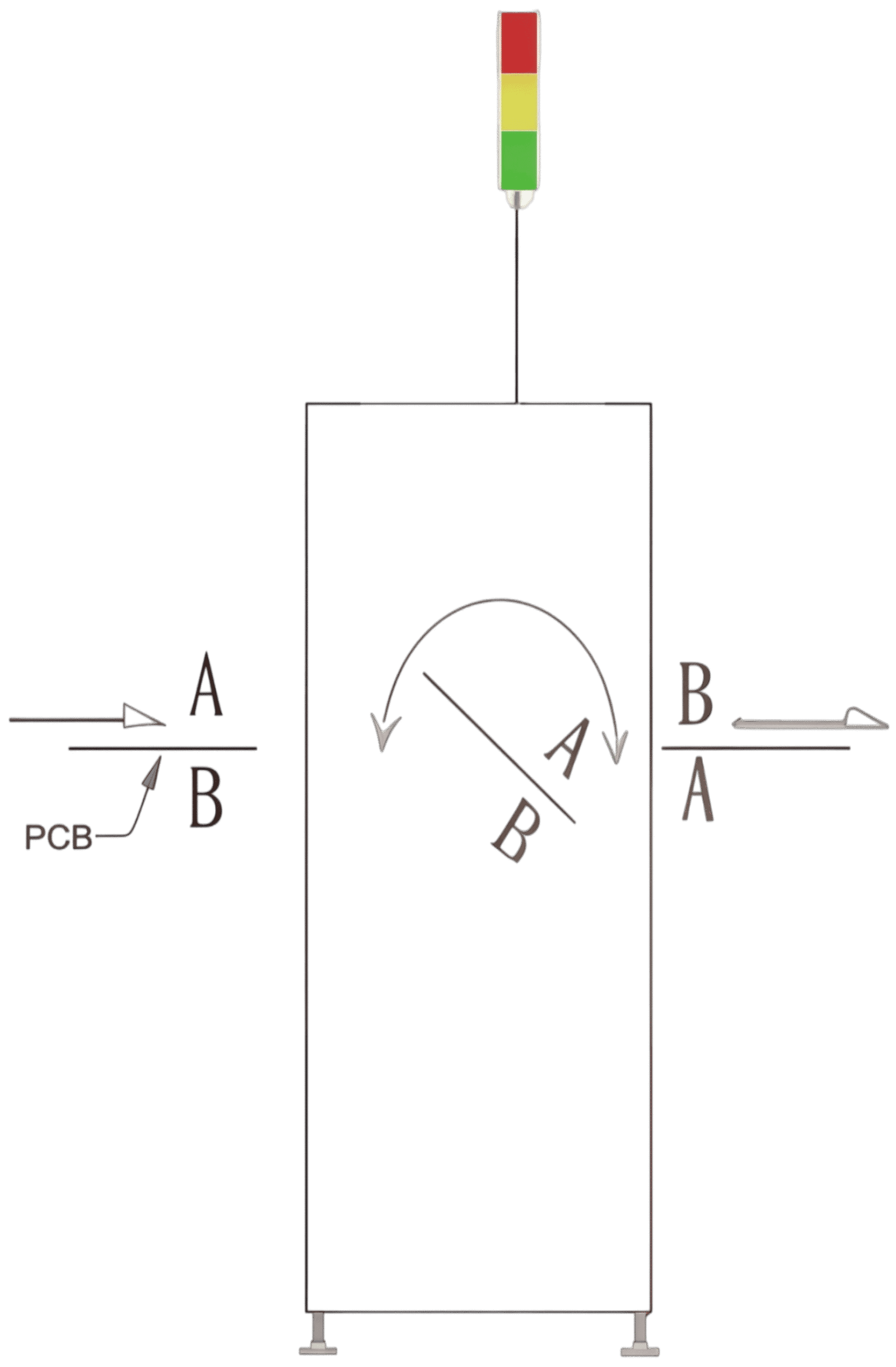
A battery charging controller may pass through printing, component placement, soldering, inspection, and electrical verification, but the board’s orientation determines which operations can be performed at each stage. The PCB Flip Machine addresses this production requirement by changing the PCB’s facing direction through a controlled 180-degree inversion. Installed at a suitable point between SMT stations, it enables a populated board to continue toward the next operation with the required surface accessible. This is particularly relevant to charging control boards and energy storage communication circuits that combine components on both sides of the substrate.
In an automated battery electronics line, transfer timing and equipment communication must be considered alongside the inversion function. PLC-based control coordinates the machine’s operating sequence, while detection sensors provide signals for board handling. Where the selected model supports SMEMA-compatible communication, the machine can exchange relevant transfer signals with compatible neighboring equipment. A touchscreen interface, when included, allows operators to select working functions and manage routine machine operation. The available inversion modes can also help accommodate different board-routing instructions. However, the machine’s cycle time should be evaluated against the actual takt time of the line rather than considered in isolation.
The most effective installation is one that matches the production route rather than forcing the route to accommodate an unsuitable machine. Engineers should check conveyor elevation, transfer direction, PCB dimensions, component clearance, and the physical space required for the inversion mechanism. These details are especially important when a factory manufactures charging controllers with different connector positions or power-component layouts. With the interface conditions verified, the PCB Flip Machine can become a dedicated orientation-control station within the assembly line. Yinuo’s YF-350 and YF-460 models can be assessed against these requirements to determine which configuration best suits the factory’s battery electronics production needs.
Spezifikationen
| Modell | YF-350 | YF-460 |
| Abmessung (mm) | 500*725*1250 | 600*856*1250 |
| PCB Size(mm) | 50*50-445*350 | 50*50-550*460 |
| Cycle Time | Approx. 10 seconds | |
| Belt Type | Oblate Belt | |
| Stromversorgung | AC 1P 110V/220V; Max 150VA | |
| Air pressure | 4-6bar, 1.1 ltr/min Max | |
| Transport Height | 900±20mm(or customized) | |
| Transport Direction | From left to right or right to left | |
| Weight(KG) | 120 | 160 |
FQA
1.Q:Which industries use PCB Flip Machines?
A:Common applications include automotive electronics, battery electronics, consumer electronics, LED products, and industrial control systems.
2.Q:How does a PCB Flip Machine improve production?
A:It reduces manual board repositioning and establishes a dedicated, repeatable inversion process.
3.Q:What is the inversion angle of a PCB Flip Machine?
A:The standard inversion function changes PCB orientation by 180°.
4.Q:Can a PCB Flip Machine invert a board back to its original orientation?
A:Selected models support invert-back operation, depending on their configuration.
5.Q:How can I choose the right PCB Flip Machine?
A:Compare PCB size, component clearance, required operating modes, cycle time, and SMT line interfaces before selection.
Yinuo Electronics Co., Limited specializes in SMT and PCB assembly equipment, offering a range of solutions for electronics manufacturing. Our product portfolio supports different stages of the production process, helping manufacturers select suitable equipment for their operational needs. We are committed to providing practical products and professional assistance to customers worldwide.
Our website is: www.esmte.com | Contact email: info@allaismt.com | Video channel: https://www.youtube.com/@allaismt/videos | WhatsApp: +8613760481664